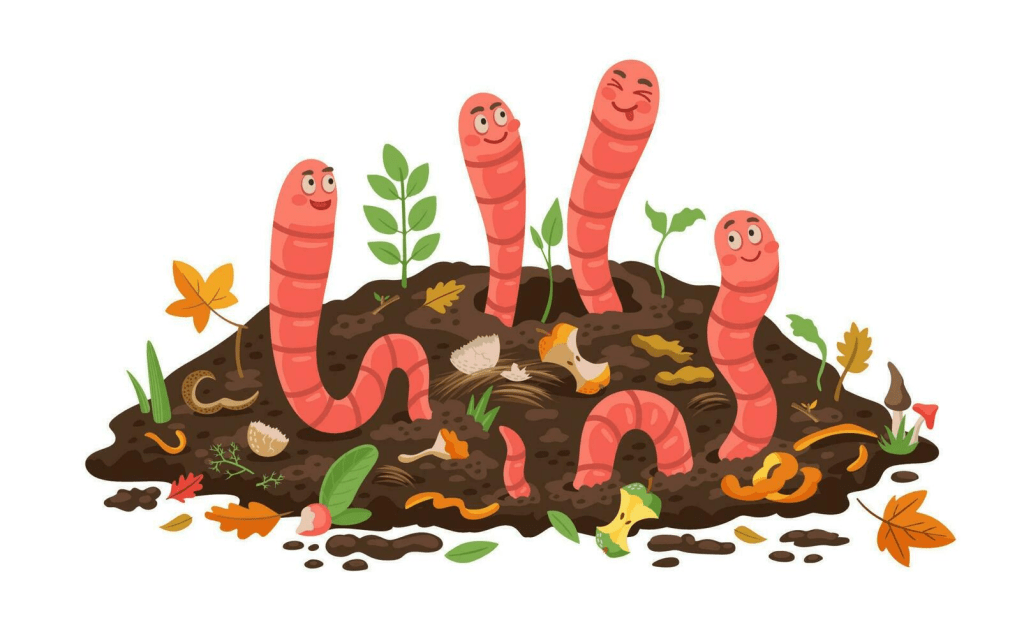
In the lower tiers of the Enchanted Trowel, beneath the polite society of nasturtiums and the rather self-important tomatoes, resides a colony of quiet industry so refined in purpose that one hesitates to call it labor at all. They are known, collectively and with no small degree of democratic insistence, as The Steves.
One must understand that this is not a name but an office, a tradition, a philosophy, even. For in the dim, loamy salons of their cedar-walled domain, individuality is surrendered in favor of a shared devotion to transformation, of peel to possibility, rind to renaissance. They are, in their way, alchemists of the Pacific Northwest: turning the detritus of kitchen ambition into the very substance of future bloom, all without so much as a whiff of self-congratulation.
It has been suggested, though never in their hearing, that their operations lack a certain ceremony. No waistcoats, no polished silver tea service, no resonant pronouncements at the ringing of a dinner bell. Mr. Carson, were he to descend into their cool, earthen corridors, might raise an eyebrow (immaculately groomed, one assumes) at the absence of hierarchy or heraldry. And yet, one suspects he would find himself, however reluctantly, impressed.
For where Mr. Carson maintains order through precision and propriety, The Steves achieve it through an altogether more elemental choreography. Each turn of the soil, each quiet ingestion, is executed with a tacit understanding bordering on the orchestral. There is no need for a butler when one has a thousand tireless stewards, each committed to the quiet dignity of decay properly managed.
And so, while the upper garden basks in sunlight and admiration, it is The Steves who ensure that such grandeur is, quite literally, well-grounded. They do not announce their presence. They do not seek applause. But make no mistake: without them, the entire enterprise would collapse into a most undignified state, something even Mr. Carson could not set right with a polished glance and a well-timed cough.
In the shaded undercroft of the Enchanted Trowel, where cedar boards creak with quiet dignity and the soil holds court in rich, fragrant layers, an unusual assembly had convened.
Mr. Carson stood, immaculate as ever, though one suspected his shoes had already suffered irreparable indignity. Gerald, whose exact role in the garden remained somewhat fluid, though he carried himself as a liaison of sorts, hovered diplomatically between parties.
At their feet, a gentle but unmistakably coordinated stirring of earth.
Mr. Carson:
I shall come directly to the point. While I appreciate…industry in all its forms, I find myself compelled to question whether this—(he gestures, ever so slightly, downward)—must occur quite so…visibly.
Gerald:
Ah. Yes. Well. You see, Mr. Carson, The Steves have asked for an audience.
(A pause. The soil shifts. A voice, or rather, a chorus with remarkable unity, emerges, warm and composed.)
The Steves:
We thank you for your time, Mr. Carson. We recognize your commitment to order, presentation, and the delicate choreography of a well-run estate.
Mr. Carson (stiffly):
It is gratifying to be understood.
The Steves:
And it is in that spirit of mutual respect that we wish to address a most persistent misconception: that we are, in your estimation, disgusting.
(A faint tightening at the corner of Carson’s mouth.)
Mr. Carson:
I would not say, well, I might say it privately, but never without cause.
Gerald (cheerfully):
Progress! We’re already negotiating terms.
The Steves:
Permit us to reframe. What you observe is not disorder, but transformation. What appears to be decay is, in fact, preparation. We take what is cast off, peels, stems, the occasional overambitious zucchini, and render it suitable for continued service to the garden.
Mr. Carson:
Composting.
The Steves:
Precisely. Though we prefer to think of it as nutritional diplomacy.
Gerald:
They’re very good at branding.
Mr. Carson (after a pause):
And you contend this…activity elevates your position?
The Steves:
We do not contend. We simply observe. The garden flourishes above because we labor below. Without us, your roses would falter, your herbs would lose vigor, and your tomatoes, however self-important, would collapse into mediocrity.
Gerald (nodding solemnly):
No one wants a mediocre tomato, Mr. Carson.
Mr. Carson (quietly):
Certainly not.
(A longer pause. One senses calculations being made, standards weighed against outcomes.)
Mr. Carson:
And this title you have adopted…?
The Steves:
Vice Presidents of the Garden.
Mr. Carson (arching a brow):
A rather ambitious designation.
The Steves:
On the contrary, we do not preside over appearances; that honor remains, quite rightly, above ground. But we oversee continuity, sustainability, and the quiet assurances that all things proceed as they ought.
Gerald:
Think of them as…operations.
Mr. Carson (slowly):
Every great house does, indeed, rely upon those who ensure its unseen functions. Kitchens, cellars…staff who are seldom acknowledged, yet indispensable.
The Steves:
We find your comparison apt.
(A faint shift in tone. Not quite warmth, but no longer resistance.)
Mr. Carson:
I shall concede this: while your methods may lack…ceremony, your results are difficult to dispute.
Gerald (grinning):
High praise. That’s practically a medal.
Mr. Carson (with measured dignity):
Let us not be carried away.
(A subtle, collective rustle, one might almost call it satisfaction.)
The Steves:
We ask for no accolades, Mr. Carson. Only recognition that what lies beneath is no less essential than what is seen above.
Mr. Carson (after a moment):
Very well. Vice Presidents…you may continue your…operations.
Gerald:
I’ll have that engraved somewhere.
Mr. Carson:
You will do no such thing.
But as he turned to leave, one might have noticed, had one been looking closely, that Mr. Carson stepped rather more carefully, as though mindful not to disturb the distinguished executives beneath his feet.

