The Importance of Ignoring the Garden (Because… Life)
Christy the Gardener, Aug. 5, 2026
“Instructions for living a life: Pay attention. Be astonished. Tell about it.”
—Mary Oliver
There comes a point every summer when a gardener walks to the back door, coffee in hand, peers toward the vegetable beds, and quietly says, “Well… not today.”
In my case, ignoring the garden wasn’t an act of surrender. It was planned months in advance. When I tucked tiny seedlings into soil in my garage back in February, I already knew I would spend two and a half weeks at the National Scout Jamboree in West Virginia, followed by a mere four-day break before heading to do more Scouting at Sea Base in St. Thomas.
This wasn’t neglect, but the conscious decision to prioritize people over plants. Sometimes life insists on being lived somewhere other than between the bean poles. There were late nights at the Summit Bechtel Reserve with some of my favorite people, endless laundry, packing and unpacking, far too many emails, and the inevitable return to work. During the few days at home, I also had to reassure Gandalf the Australian Shepherd that he was, in fact, still my favorite creature on Earth and make a desperate grocery run so that actual vegetables, not just camp food, might find their way onto my plate.
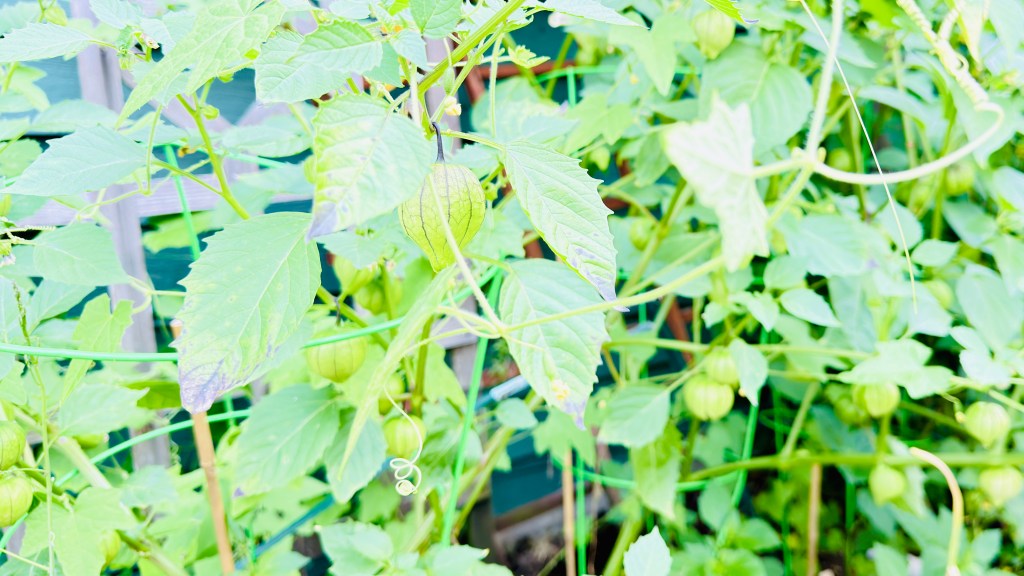
As far as I can tell, the garden understands. Mostly. While I’ve been busy living life, the cucamelon apparently decided it is no longer content climbing its own trellis. It embarked on a grand expedition across neighboring territories, wrapping enthusiastic little tendrils around the tomatillos. Whether this is friendship, conquest, or an elaborate vegetable square dance, I cannot yet determine. Will I even be able to harvest them when I return? I have no idea, but it may require archaeological excavation.
The tomatillos, for their part, seem completely unfazed. They continue producing their cheerful lantern-like husks as though sharing personal space with an overly affectionate cucumber impersonator is perfectly normal.
The tomatoes are conducting their annual experiment in unpredictability. One plant is bursting with fruit, and another has spent the last six weeks contemplating the meaning of existence while growing approximately one inch. A third has proudly produced exactly three tomatoes all season with the confidence of a plant convinced it has exceeded every expectation. In fact, it has not.
The zucchini, naturally, ignored all human schedules and has instead dedicated itself to producing spectacular blossom-end rot. Fortunately, I’m the only person in the house who truly enjoys zucchini, so perhaps this is less of a tragedy than it appears.
The weeds, meanwhile, held several committee meetings during my absence. Some reached an impressive four feet tall in just two weeks. Frankly, they should offer motivational seminars for the tomatoes. They’ve expanded operations, opened regional offices, and appear to have hired consultants. Invasive bindweed entered the chat with all the confidence of someone who has never once heard the word boundaries.
And yet… despite my absence, the bees still arrive every morning. The goldfinches continue inspecting the sunflowers, and the flowers themselves are in rare form. The earthworms quietly work beneath the soil without filing a single complaint, and the garlic cured itself in the garage. The sweet peas flourished under what can only be described as benign neglect, while the dahlias bloomed anyway, filling every vase in my kitchen.
Nature, it turns out, has never expected perfection, only participation.
Gardening has a curious way of reminding us that we are partners, not managers. We like to imagine we’re in charge because we bought the trowel, memorized the seed packets, and carefully mapped out our beds in February. The garden smiles kindly at our confidence.
Rain falls when it wishes, and smoke drifts across the sky from wildfires hundreds of miles away, reminding us that some people are losing far more than gardens. At home, slugs arrive without invitations, and volunteer tomatoes emerge from the compost with astonishing optimism. The squash vine borer has clearly never read my carefully crafted plans. In other words, the world spins madly on. Perhaps that’s the lesson hidden beneath the tangle of cucamelons. Sometimes the best thing we can do is stop apologizing for the imperfect garden. It isn’t a museum exhibit, but evidence of a life well lived as the overgrown pathways tell stories of camping trips and adventures. The missed deadheading marks evenings spent helping others, and the weeds testify that you were somewhere else making memories.
Raging Into Summer
By Christy the Gardener, The Gentle Garden – June 23, 2026
There comes a moment every year when the garden stops being a peaceful hobby and becomes a full-contact sport. In spring, I move through the beds with gentle purpose. I lovingly tuck seedlings into the soil and admire emerging leaves. I whisper encouraging words to tomatoes and carefully place supports where future vines will surely need them.
By July, I can barely find the supports. The peas have launched a hostile takeover of one corner. The squash is making territorial claims in another while volunteer plants appear everywhere like tiny squatters. The strawberries, which I once considered charming and productive, have sent runners in every direction and are now attempting to annex neighboring counties. The pathways? While they are, theoretically, still there, a hummingbird friendly plant that I forgot the name of self-seeded iitself 12 feet from where it was originally located and is now blocking the path. II find myself pushing through foliage like an explorer hacking through a jungle, emerging scratched, sweaty, and carrying a basket that somehow contains three zucchini and a flower I don’t remember planting.
Every summer I make the same promise. “This is the year we’re going to savor every moment.” We’re going to picnic, paddleboard, sit on the deck, and watch sunsets. We’re going to read books in egg chairs and enjoy every precious ray of Pacific Northwest sunshine. Every August, I find myself limping toward Labor Day like a marathon runner approaching the finish line. Abundance isn’t just a garden phenomenon; it’s a life phenomenon.
The calendar fills as quickly as the raised beds with all the things we waited through the rainy months to finally do arrive at once. This year, we’ve added an extra adventure as we are preparing to launch a child to college.
Apparently, there are forms, housing assignments, orientation schedules, shopping lists, financial paperwork, emotional preparations, and approximately 17,000 things that need attention before move-in day. I admit that I am tired already, and it’s only June. (You will notice that less blogging is a part of this chaos).
One warm afternoon, I found Mildred Witherspoon sitting on a garden bench fanning herself with a seed catalog.
Mr. Carson, the ever-dignified concrete frog butler, approached carrying a tiny silver tray.
“Good heavens, Mildred,” he said. “You appear exhausted.”
“I am exhausted,” Mildred replied. “The garden is growing faster than I can keep up.”
Mr. Carson surveyed the beds thoughtfully.
“The tomatoes are flourishing.”
“Too much.”
“The strawberries are productive.”
“Far too productive.”
“The zucchini seem healthy.”
“They know what they’ve done.”
Mr. Carson nodded solemnly.
“A common midsummer condition.”
“And what is that?”
“Believing one must personally keep pace with every growing thing.”
Mildred stared.
“Isn’t that the gardener’s job?”
“No,” said Mr. Carson. “The gardener’s job is to tend the garden. Not become one of the plants.”
Mildred blinked.
“That sounds suspiciously wise.”
“I read it on a seed packet.”
The truth is that gardens teach us lessons we often resist learning. In June, I feed my roses alfalfa and deadhead spent blooms. The roses have already given so much energy to their first flush of flowers that they need nourishment if they are going to continue thriving through the season. No one looks at a rose bush and says, “You bloomed beautifully in June. Now please continue performing indefinitely without food, water, or care.” Yet, many of us say exactly that to ourselves.
We pour energy into work, family, volunteering, parenting, caregiving, gardening, and every worthy thing that calls our attention. Then we wonder why we’re running on empty by midsummer. The garden reminds me that growth requires replenishment.
Sometimes the most productive thing we can do is eat lunch on the deck or take a walk. Remind yourself to take an evening when the only goal is to read a chapter of a book and go to bed early. Or maybe sit quietly with a cup of tea and watch the bees work the lavender.
Theodore Roosevelt once said:
“Do what you can, with what you have, where you are.”
In the frenzy of summer, I find that quote especially comforting. I don’t have to weed every bed today. I don’t have to solve every college preparation task this week. I don’t have to wring every possible experience out of every sunny day. I simply have to do what I can, with what I have, where I am. The garden will still be there tomorrow. The strawberries certainly will.
As August approaches and the garden reaches its annual state of glorious chaos, I am trying to remember that abundance is not something to conquer. It is something to appreciate. And a final reminder, if you want to keep blooming, don’t forget to feed the roots.
The Gardener: The Year I Accidentally Became Responsible for 350 More Plants
There are moments in life when you have what feels like a perfectly reasonable idea.
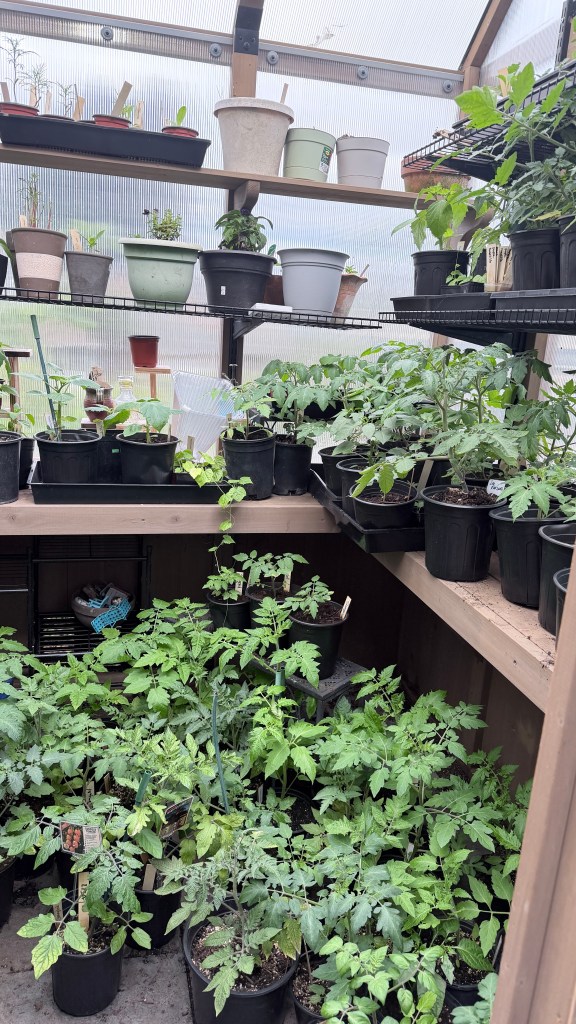
However, there are moments several months later when you are standing in your driveway surrounded by 350 gallon-sized plant starts, wondering exactly where your judgment went wrong (or right, depending on how you look at it).
Welcome to spring.
It started innocently enough. Our Scouting America troop needed fundraising ideas to help support summer adventures. We have four boats heading to Florida and St. Thomas Sea Base this year, along with summer camp and all the other wonderful, expensive, muddy, character-building things Scouts do. We try hard to encourage the kids to help pay their own way whenever possible. Adventure means more when you’ve worked for it.
A plant sale seemed absolutely perfect for a troop filled with gardening adults.
The Scouts could help grow plants, learn propagation, care, watering schedules, and even work toward Gardening and Plant Science Merit Badges along the way. Educational! Practical! Community-building!
This all sounded very noble and organized back in January.
January, for the record, is an extremely dangerous month for gardeners because it is cold and dark. Seed catalogs arrive glowing with false promises and professionally photographed tomatoes. You begin believing things like, “I probably have room for 40 peppers.”
Then suddenly you’re elbow-deep in potting soil at midnight whispering, “One more tray won’t hurt.”
This fundraiser became, in part, an absolutely excellent excuse to start planting early and simply… never stop.
Friends, I did not stop.
I planted tomatoes, peppers, herbs, squash, flowers, pollinator plants, strawberries, hostas, divided daisies, and irises. If it rooted, sprouted, divided, or looked vaguely hopeful, it ended up in a pot.
Mildred, naturally, saw where this was heading long before I did. She simply poured herself an extra cup of tea, gave me The Look, and made a little sign for the sale.
Mr. Carson peered at me over his glasses at least twice a week and gave a disappointed little tsk every time another tray appeared.
Gerald, of course, helped. Because Gerald always helps, even when he absolutely should not encourage me.
The Builder participated, too, although his contribution included breaking my favorite tactical assault shovel while digging hostas, which I am definitely not over yet. However, I am grateful that he had the muscle to remove some hostas that were overtaking my peonies, so he is almost out of the doghouse.
Somewhere along the line, I became caretaker to over 350 additional plants.
I repeat, three hundred and fifty.
Do you know how many times a day these plants need to be watered during a random warm week in May? It turns out: MANY. Every flat needs turning. Every tray dries out differently. Every tomato suddenly decides it is six feet tall overnight or it ends up in the “clinic” where it gets extra TLC when really it should just be composted.
And honestly? I love every ridiculous second of it.
Because yes, this is for the kids.
It’s for the Scouts learning responsibility, teamwork, leadership, sailing skills, swimming skills, resilience, independence, and confidence. It’s for those moments out on the water or around campfires where they discover they can do hard things. It is for Saturday and Sunday where they will help explain the difference between determinate and indeterminate tomatoes.
But let’s also be honest. It’s for me too.
Gardeners understand this particular condition. The absolute inability to accurately estimate how much work is involved in “just a few more plants.”
We do it again and again because growing things feels hopeful. Because tiny seeds becoming food and flowers still feels a little miraculous every single time.
So, if you’re around Bothell this weekend, come visit our plant sale. Please. Truly. Help me find homes for these lovingly seeded vegetable starts, flowers, herbs, strawberries, and assorted garden chaos before I completely lose my mind. Each one even comes with an adorable baseball type identification card.
You’ll leave with beautiful plants grown with care, and you’ll help support some pretty amazing kiddos as they head off toward summer adventures and lifelong memories.
And if you happen to see me hauling another tray of tomatoes out of the garage while muttering to myself?
No you didn’t.

I Considered A Garden Year-Round (Then Remembered I Like Blankets)
There are ideas that arrive like a warm wind at the garden gate, full of promise, smelling faintly of possibility, and for a moment, you are certain they were meant just for you.
I had one of those moments not long ago, standing in the kitchen with a cup of tea and the first issue of a newly arrived Gardening Nation spread open before me. The paper itself felt like an old friend. I was, once upon a time, a print journalism major, the editor of the daily student newspaper, no less. I was a 19-year-old with ink on my fingers, deadlines humming, and the quiet satisfaction of a story well told. For years afterward, we subscribed faithfully to the daily paper. Until, if I’m honest, we didn’t. The cost rose, my attention waned, and the stack of unread pages found their final purpose tucked neatly into garden beds, suppressing weeds rather than informing minds.
Canceling that subscription felt oddly like grief in the form of a small, papery heartbreak.
So, when I discovered a monthly newspaper devoted entirely to gardening, I let myself hope again. And there it was, in the very first issue: a long and earnest article on something called continuous gardening.
The premise is simple, at least on the surface. Continuous gardening is the practice of keeping the garden in production year-round with no fallow periods, no true end or beginning. As one crop finishes, another is already waiting in the wings. It involves succession planting, cold frames, hoop houses, overwintering crops, and careful planning of varieties that can withstand frost or mature in shorter light. It is, in its way, a kind of choreography, an unbroken dance between soil, seed, and season.
And I felt it…….that spark.
Imagine, I thought, what could be grown. Imagine wringing every last ounce of productivity from the garden, even here, where winters settle in cold and wet and gray. Imagine stepping outside in January to harvest something green, something alive, something that defies the quiet.
My ears perked. My pencil hovered. I was, briefly, converted. Then, just as quickly, another image followed.
I, standing in the garden in February in my Duluth Trading Company overalls, with my National Park wellies on. A soaked garden martyr in the rain, with boots that never quite dry, hands stiff with cold, mucking about in beds that do not want to be disturbed, while the sky presses low. The house behind me is warm, and there is a book waiting by the fire.
I hesitated.
Continuous gardening, I realized, is not just a technique; it is a philosophy. It asks something more than skill; it asks constancy and attention without pause. It requires a willingness to remain “on,” season after season, without the long exhale that winter has always offered. Give up my Wintering, I can’t even imagine such a thing.
There are places where such a rhythm makes sense, milder climates where the earth rarely closes its doors, or for those who find deep joy in that steady, unbroken tending. There is nothing inherently wrong with it. In fact, there is something admirable in its diligence, its refusal to let the garden sleep.
I have come to understand that I need the sleep, the rest, the respite, the permission to take a deep breath.
I need the seasons not just as a gardener, but as a person.
I need the bright urgency of spring, when everything feels possible, and I am all plans and seedlings and dirt under my nails. I need the fullness of summer, when the garden hums along and I follow its lead, where I stress and recognize that my spring self overestimated my summer energy. I need the slowing of autumn, the pulling back, the gathering in.
And then……I need winter.
I need the time when I am not responsible for extra living things. A moment when nothing depends on me to be watered, weeded, or watched. When the garden and I agree, silently, to rest. There is a kind of mercy in that; a permission to not be productive, to not optimize, to not improve. To simply be.
Winter is when I return to books, quiet mornings, naps that stretch longer than intended. It is when the mind composts its own season, turning over ideas, letting what is no longer needed break down, making room for what will come next.
Continuous gardening offers abundance. But rest offers renewal. I suspect that, for me, the garden is not diminished by its pauses. It is made whole by them.
So, I folded the newspaper, carefully this time, not for lining beds (yet), and set it aside. The idea of continuous gardening will stay with me, I think. It will visit now and then, especially on those unseasonably warm winter days when the soil almost calls my name. I will answer, gently, with a “no.”
There is a season for everything, after all. Even for doing nothing at all.
Last weekend, I turned 51.
My hair is graying, and my knees now announce themselves every time I stand up from weeding, as if they’d like recognition for their service. Gardening, it turns out, is not a quiet hobby. It is a conversation between you and your body, and lately, my body has opinions.
And yet… this might have been one of the best birthdays I’ve ever had.
Which is saying something, because I am, by all reasonable measures, completely spoiled by my guys.
At 40, The Builder surprised me with a camper. Not just any camper, a tiny rolling promise of adventure that we named George, because of course we did. At 50, he built me a greenhouse. This is on top of the world’s cutest front yard-she shed that is named Hagrid’s Hut.
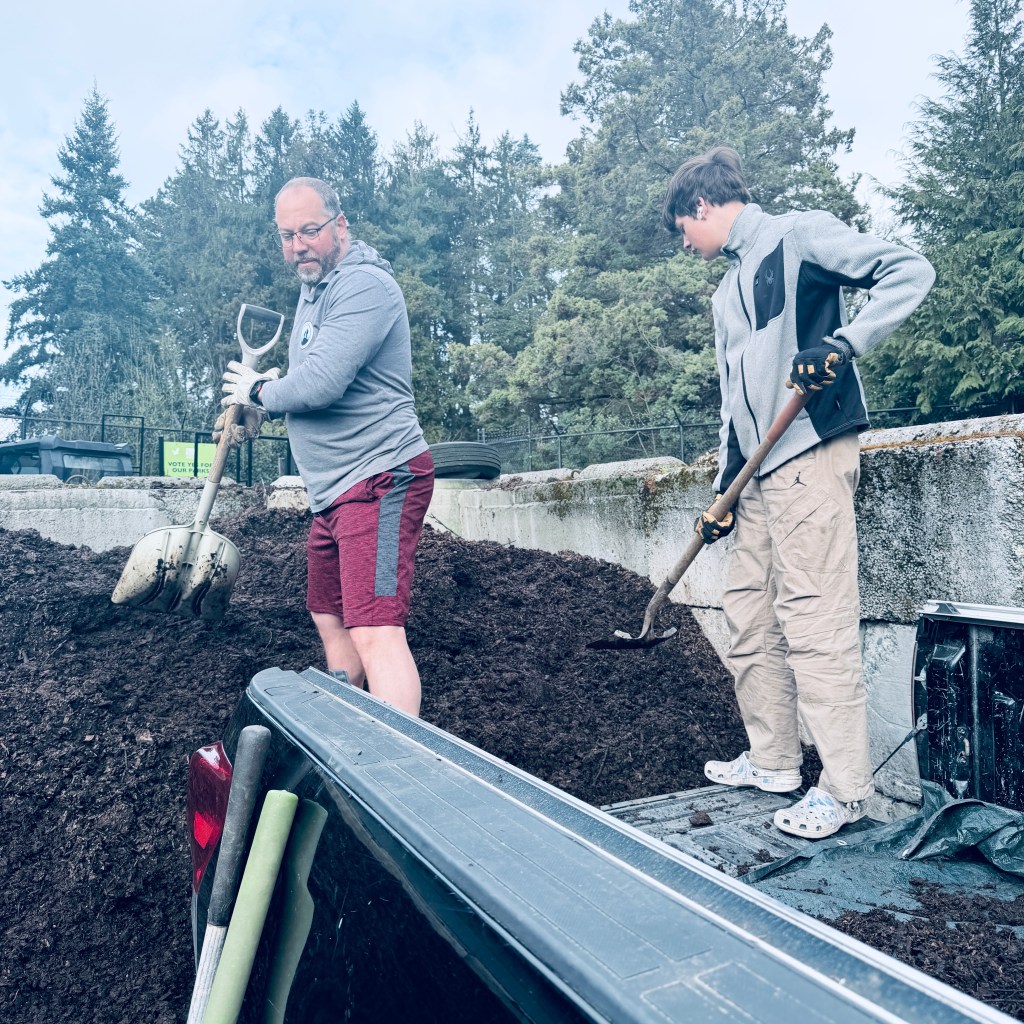
This year, he won the Woodland Park Zoo Doo lottery, which, if you’re unfamiliar, is exactly what it sounds like: premium composted zoo manure. He loaded the youngest into the truck, and they shoveled an entire load in and out like it was some kind of rite of passage. There are families who go to Disneyland, but we haul exotic animal poop. Everyone has their thing.
This year, though, there was no single grand reveal. No ribbon. No ta-da moment. Instead, there was something better.
The oldest, firmly in what we affectionately call his Big Lebowski era, has adopted a wardrobe of Hawaiian shirts, flip-flops, and a general air of philosophical wandering. He asked, casually, if he could redo a front flower bed for my birthday.
Then he took me on a walk.
We wandered the neighborhood while he pointed out plants. This would look good here. That one would soften the corner. What about a cherry tree? Maybe an arbor? It was part design consultation, part daydream, part quiet understanding of who I am at my core.
And then, he actually did it. He is in the midst of final projects for his junior year of college, and yet he spent the entire weekend digging out grass, carving space from lawn into possibility.
The younger one took to the shovel and mulch, circling my two new raised beds with the kind of focus that only comes when you know your work matters to someone you love.
No one had to do any of this. Gardening is, objectively, not their thing. And yet, here they were, digging, hauling, planning, imagining, meeting me in a world that brings me joy.
That’s the thing about a good birthday at 51. It’s not about the big gift (though I will never complain about a greenhouse or a truckload of zoo compost). It’s about being known. Fully, clearly, and with such generosity that the people you love step into your joy, even when it isn’t naturally theirs.
It’s about a husband who understands that a pile of compost can feel like treasure and who agrees to build a new L-shaped bed next to the greenhouse and burns memorial signs for my garden to help me remember two special people. A son who sees beauty in a future cherry tree and wants to help plant it. Another who quietly spreads mulch like he’s tucking the garden in for the night.
I may have won the Zoo Doo lottery once. But standing there, looking at a half-finished flower bed, dirt under everyone’s nails, plans in the air… It felt like I won the lottery of life, not because it is perfect but because it is full of heart.
An Ash Wednesday Garden Reflection
From The Gardener
Feb. 18, 2026
Today, the garden wears ash.
Not sackcloth exactly
more like last year’s tomato vines collapsed into themselves,
powdered mildew on hellebores,
last year’s sunflower stems are dead and decomposing.
I press that gray dust into my palm
and think:
This is what becomes of everything
that once reached wildly toward the sun.
Ash Wednesday arrives
like the quiet gardener of the soul
no trumpet, no blossom parade
just a soft thumb of soot
brushed across the forehead of the earth.
Remember you are soil,
The garden whispers.
And to soil you will return.
It is not a threat.
It is a promise.
Because I have seen what soil can do.
I have seen it hold the memory of frost
and still welcome seed.
I have watched it rest all winter,
apparently empty,
while roots stitched themselves deeper
in the dark.
Rest is not failure.
It is the composting of what was.
The beds look bare now
no zinnias flinging their neon joy,
no snapdragons gossiping in the breeze.
Just quiet,
A holy pause.
I am tempted to rush it.
To scratch and sow and hurry redemption along.
But the garden keeps better time than I do.
Ash settles.
Rain follows.
Worms begin their patient turning.
Redemption rarely arrives as fireworks.
It comes as decomposition,
old pride softened,
old habits broken down,
old grief worked back into usefulness.
The gardener in me wants blossoms.
The soil in me needs breaking.
So today I kneel
not to admire abundance
but to bless the barrenness.
To thank the ash
for reminding me that what has burned
can still nourish.
To honor the reset,
the clean sweep of frost,
the mercy of empty beds,
the sacred rest before germination.
If seeds can begin in darkness,
if roots can push through cold clay,
if last year’s failure can become this year’s fertility,
then perhaps I can, too.
Ash on my brow.
Dirt under my nails.
Hope hidden, not absent.
The garden is not dead.
It is becoming.
And so am I.
A transfiguration.
February 2, 2026
Seeds, Snips, and the Secret Lives of Overgrown Dreams
A Garden Conversation with the Gardener and Mildred & Gerald the Gnomes
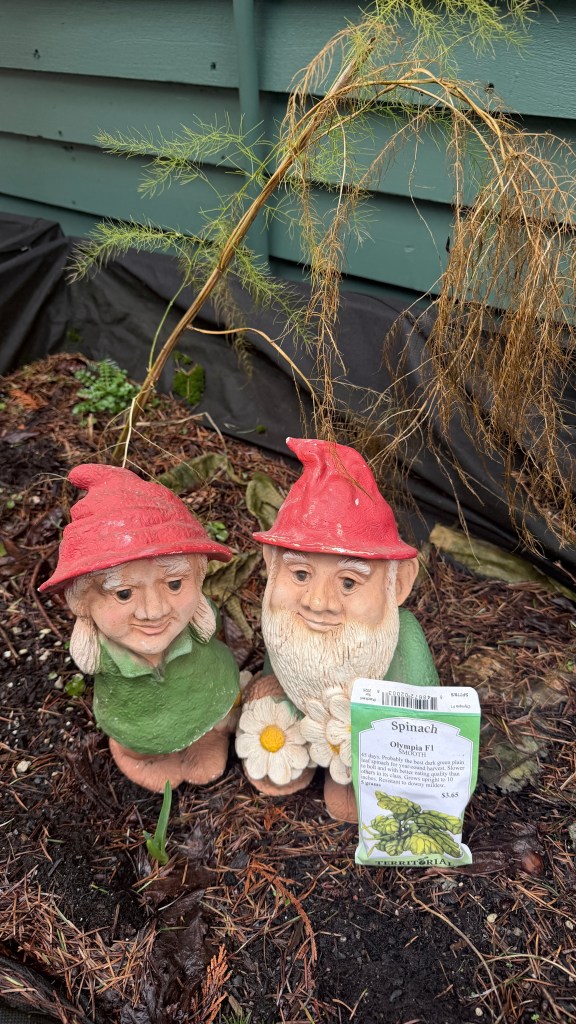
The morning began the way all sensible garden mornings should: with dirt under my nails, coffee in my hand, and two opinionated garden gnomes arguing in the VegTrug.
Mildred was standing on a packet of spinach seeds like a general on a hill. Gerald was glaring at the weeds that were working to overtake the garlic planted last fall.
“Gardener,” Mildred called, hands on her tiny hips, “you can’t just plant without planning.”
“And you can’t just plan without dreaming,” Gerald added, pulling a snail from his hat. It had been a wet winter in the PNW and the slugs and snails were already at work.
Which, honestly, is the entire philosophy of life summed up before breakfast.
Planting seeds is an act of hope. You take something small, unimpressive, and nearly invisible, and you say, I believe you can become something.
I stood outside, looking at my VegTrug, and pressed spinach into the soil around the garlic.
“What are you planting?” Mildred asked.
“Greens,” I said.
“Ah,” Gerald nodded wisely. “But what are you planting in yourself?”
Rude. Helpful. But rude.
In the garden, planting is about intention. You don’t scatter tomato seeds in the shade and hope for miracles. You think about space, light, nutrients, and timing.
Life works the same way.
If you want calm, you plant boundaries.
If you want creativity, you plant curiosity.
If you want a connection, you plant time.
Too often, we wish for a harvest without choosing the seed intentionally
Mildred dusted off her apron, her red hat askew. “People say they want joy, but keep planting worry. Then they’re shocked when anxiety comes up instead of daisies.”
She’s tiny, but she cuts deep.
Then came the harder part. Finding the space to plant the things.
I lifted my pruners. The asparagus sprig in the VegTrug was way overdue for a prune.
Gerald sighed. “Everyone hates this part.”
Cutting back feels cruel until you understand it’s an act of love. You don’t cut because you’re angry at the plant. You cut because you want it healthier, stronger, and able to breathe again. For asparagus, this keeps pests at bay and makes healthier spring sprigs.
Mildred climbed onto the clematis trellis next to the rose. “How often do humans just let things grow without asking if they still serve them?”
She wasn’t talking about plants anymore.
We let commitments grow.
We let habits sprawl.
We let relationships tangle.
We let fears root so deeply that we forget they were ever optional.
Sometimes what once protected us starts blocking the light.
“Prune back,” Gerald said softly. “Not because something is bad, but because it has overtaken the space you were trying to give something new.”
In the garden, dead wood steals energy from living growth.
In life, old stories steal energy from becoming.
Pruning asks brave questions:
- Is this still healthy?
- Is this still growing?
- Is this still mine to carry?
Snip.
Release.
Make room.
For Something.
For something new.
For something sacred.
For something intentional.
Here’s the secret Mildred whispered while riding in my pocket:
“You can’t just clear space. You have to decide what belongs there next.”
If you only prune, life feels empty.
If you only plant, life gets crowded.
Balance is the magic.
Cut back what no longer fits.
Plant what you want to become.
Want more peace? Prune noise and plant stillness.
Want more courage? Prune doubt and plant action.
Want more beauty? Prune neglect and plant attention.
I paused, leaning on my shovel, and thought of Thoreau in Walden, who reminded us that life is not about rushing blindly forward, but choosing our direction:
“I wished to live deliberately, to front only the essential facts of life, and see if I could not learn what it had to teach.”
Gardening is deliberate living with dirt on your knees and under your fingernails.
And later, when Thoreau wrote about walking our own way, he offered another truth the gnomes, Gerald in particular, adore:
“If one advances confidently in the direction of his dreams, and endeavors to live the life which he has imagined, he will meet with a success unexpected in common hours.”
Plant toward your dreams.
Prune toward your health.
As the sun slid lower, Mildred sat on a seed tray in The Enchanted Trowel Garden Shed, and Gerald leaned against a dead begonia that refused to overwinter.
“So,” Mildred asked, “what are you cutting back?”
“And what are you planting?” Gerald added.
I looked at the open soil, the newly planted jalapenos, the tiny seeds waiting in darkness to begin.
Life, like a garden, isn’t about letting everything grow forever.
It’s about choosing what deserves your light.
Prune what crowds your heart.
Plant what feeds your soul.
Mildred grinned. “Now that’s good gardening.”
Gerald tipped his hat. “And better living.”
And somewhere between the seeds and the snips, the garden, and maybe the gardener, began again.
January 1, 2026
Here in the Pacific Northwest, where moss considers itself an interior design choice and the clouds have strong opinions about lingering, I don’t do New Year’s resolutions. Never have, never will.
Resolutions feel a bit like promising you’ll never again track mud into the house while wearing boots that were made for mud. I admire the optimism. I just know myself better than that.
Instead, I pick a word of the year, something to hold gently in my pocket, like a smooth stone found on a familiar trail.
Last year’s word was grace.
Not the kind you offer easily to others (that part I’ve got down), but the kind you extend inward. Grace for missed deadlines, for tired evenings, for doing your best when your best looks suspiciously like a book, a fire, and an early bedtime. How did I do? Better. Not perfect. Still very much a work in progress. Turns out receiving grace is harder than giving it, especially when you’ve spent a lifetime believing productivity is a moral virtue.
As I’ve been contemplating the year ahead, another word keeps tapping me on the shoulder.
Slow.
I know. A strange choice. Possibly even suspicious.
But I feel like I’ve spent the last 21 years of life and parenting running. I sprint from one thing to the next event to the next meeting to the next…… Anyone who has ever shared a meal with us will note that we eat like it’s an Olympic sport: speed rounds, minimal conversation, impressive fork-to-mouth efficiency. Not because we’re starving, but because somewhere in the background, there’s always a Zoom meeting, a board meeting, a performance, or something that must be done right now.
Running a marathon for 21 years is… well… exhausting.
Gerald the garden gnome has been tsk-ing at me about this for years. He stands there, arms crossed, judging my pace. Mildred, ever the picture of wisdom, just adjusts her glasses and offers a knowing smile while crocheting yet another doily, as if to say, You’ll figure it out eventually, dear.
Slow sounds easy. It is not.
It might be my most challenging word yet because it requires adjusting the internal clock, and neither the builder nor I are particularly good at that. We are people who like plans, efficiency, and forward motion. Slow asks something different.
What might it look like?
Cooking complicated meals that require… time.
Making plans with my people that aren’t followed by, “but we have to leave by…”
Sitting in companionship without urgency.
Taking up a hobby that can’t be finished in minutes, but unfolds over months. It looks like 2026 will be about…..sewing.
I already do this with gardening, watching, waiting, trusting the quiet work beneath the soil, but literally nowhere else in my life.
Slow isn’t about stopping. It’s about not rushing past the moments that are actually the point.
So, no resolutions for me. No lists taped to the fridge. Just one small word, doing big work.
What about you?
Do you make New Year’s resolutions, or do you have another way of stepping into a New Year?
What are you hoping to grow, slowly or otherwise, this year?
October 17th, 2025

The EMPTY Nest (Or Maybe Not So Empty After All)
A reflection from The Gardener
My youngest just turned 18.
This fall is filled with college visits and so many lasts. The last marching band performance, the last first day of school photo, the last time I fill out a permission slip. With it comes the thought that makes parents everywhere wince just a little: this time next year, the Builder and I will officially be “empty nesters.”
Well, sort of. Our big kiddo is still at home, finishing up college, quietly adulting in a way that makes me proud and slightly nostalgic. My head knows this is how it’s supposed to go – healthy birds fly the nest. That was always the goal. But that doesn’t make the transition any easier.
For 21 years, our calendar has revolved around them. It’s been packed with soccer practices, art lessons, and camping trips. We’ve coached sports we had no business coaching, PTA’d our way through science fairs, hauled band equipment up hills and down stadium bleachers in the name of parenting.
And now, the thought of an empty nest doesn’t just mean kids flying off to new adventures. It means a big, empty calendar where once there was color-coded chaos and stacked activities that we divided and conquered.
So, I’ve decided to spend this last year in emotional preparation for what comes next. I’m calling it my year of introspection.
Who will I become next?
At first, I thought that I would pick up a new hobby or two. I can plan more weekends away with the Builder, perhaps. I can mark weekends on the calendar and plan a few adventures to places we’ve always said we’d visit “someday.” But as I’ve sat with the idea, I think we miss something important in all this empty nest talk:
We don’t have to give everything up. We don’t have to become… empty.
We get to choose what we want to keep.
What were the things that truly stuck? The moments that filled me with joy, purpose, and laughter? The Builder and I have always been people of community and service, and I refuse to give up those things and the people who matter. I still want to invest in the next generation. I still have the energy (and the good hiking boots) to haul a tent through the woods and march over wet bridges and fallen logs. I still get to show up, not because I have to, but because I want to.
Maybe this isn’t an ending at all, but just a new kind of beginning.
Maybe instead of “empty nest,” we call it something else:
The Next Chapter Nest.
The Becoming Years.
The ReBloom Phase.
The Rediscovery Era.
Yes, this new season will bring more time for dreams that have been waiting patiently in the wings – like this very gardening blog full of whimsical statuary and music reviews. It has been years since I had energy for something that has absolutely no purpose. Maybe I’ll finally learn to play Betty the Banjo (a Mother’s Day present that hangs on the wall after a few sad attempts went nowhere). Maybe I’ll just keep doing the things that matter, whether or not my kids are in them anymore.
Because like perennials, we get to cut back, compost, and grow again.
To bloom again.
To give joy again.
To be full again.
Because this season of life- whatever we call it –
won’t be empty.

A Year of the Chaos Garden
from Christy, the Gardener
It always starts the same way. A whisper in the algorithm. A hashtag too clever to ignore. A reel of sun-dappled pollinator patches overlaid with ukulele music. A slideshow of overgrown beds, seeds strewn with abandon.
Chaos Gardening.
The words alone give me pause, at once disorienting and seductive. It sounds less like a gardening method and more like a spiritual reckoning. A cry for help in mulch and bloom. A therapy session conducted by calendula, cosmos, and volunteer kale. A return to wildness. A rebuttal to spreadsheets, schedules, and side hustles. It’s attractive.
I sit with it for a while. Not in the garden, too many weeds I’m too tired to pull, but inside, at the breakfast table, sipping the English Breakfast I’ve reheated twice and still managed to forget about.
Should I do it? Could I?
I’ve followed the social media trends before.
There’s the pizza-making summer of 2020. The pandemic gardening craze, when raised beds were as essential as toilet paper, and people compared tomato growth like they once compared gas mileage. I even started a YouTube channel for gardening. Then I got bored.
And now: Chaos Gardening.
I click through forums and quirky blog posts. The gist is simple: skip the plan. Toss all your leftover seeds, expired, unlabeled, the mystery ones inherited from your father, into one glorious garden bed. Maybe mix them in a bowl first. Scatter them like confetti, like hope. Water and wait. See what shows up. Run through the field in a linen dress and clogs and give back to Mother Earth.
Some do it for pollinators. Some for beauty. Some just need a win that doesn’t require measuring, mapping, or making a five-year plan.
I look out at my own garden, and a thought creeps in: haven’t I already been chaos gardening all along?
There’s the time I organized my seed packets by vibe instead of vegetable. The year I color-coded all the seeds with little stickers. The time I accidentally used a dry-erase marker, and all the labels became blank. Now that’s chaos gardening.
For years, I told people that I was cultivating a classic English garden. After all, I lived in England for a year in the ‘90s. I own clippers with wooden handles and once read The Secret Garden on a rainy afternoon while drinking tea by the fire.
But this morning, with my cooling tea and a pile of unplanted seed packets on the counter, I finally admit the truth to myself:
I’m not an English gardener.
The slugs ate the zinnias. The lavender sulked. The rosemary along the rock wall died a horrible death. The “structured quadrant for herbs” became a bindweed buffet no matter how many times I pulled it back and dug it out by the long white roots. So what am I, then?
I google Chaos Garden. The internet is happy to help.
“A relaxed and unstructured approach to gardening where traditional rules and meticulous planning are set aside. Instead of planting seeds in organized rows, gardeners randomly scatter seeds and allow nature to determine what grows…”
Random.
That word again.
I bristle. My garden isn’t random. Not really. My edits may be intuitive, my placements sometimes “mood-based,” but there’s thought behind them. Intention. The tomato that grows in the middle of the bean bed isn’t part of the plan, but it insists on its place, and who am I to argue with such determination? I don’t have the heart to remove it, and that feels less like chaos and more like… grace.
Sure, things self-seed. Plants wander. Entire corners of the yard go rogue more than once. But still, there’s a plan. A loose one, evolving. More of a jazz improvisation than a chaotic free-for-all. One with some vision underneath the creeping buttercup and ever-seeding forget-me-nots.
I study the soil. I reverently circle the seeds in my garden catalogs. I research companion planting before giving up halfway through and planting whatever looks good next to each other. I make the beds, add the mulch, observe the sun. There’s intent, to the extent that intent performs.
So Chaos Garden?
Maybe.
But also… not.
The words hit like an insult disguised as a compliment. Like when someone calls your deeply lived-in house “eclectic” instead of cozy. Or worse, like pouring curdled milk into your first, beloved cup of tea on a Monday morning.
No. I’m not a chaos gardener. Not really.
I’m a hopeful improviser. A strategic dreamer. A chaotic planner.
A gardener with one foot in structure and the other in surrender.
A gentle gardener.
The Gentle Garden is not a place of perfection, but of permission. Here, weeds are forgiven, and wilted petals are simply part of the story. It’s a refuge where things grow in their own time, and the gardener’s hand is guided more by wonder than control. Moss softens the edges, ferns find their own rhythm, and blossoms appear like small acts of grace.
In the Gentle Garden, nothing is demanded, yet everything offers something. It is a reminder that beauty can thrive without striving. It is a sanctuary for slow mornings, muddied knees, and quiet conversations with the earth. The air hums with the soft insistence of life continuing, no matter what.
It is, above all else, a place that loves you back without judgment in a world that rarely does the same.
Finding the Glimmer: A Fall Reflection from the Garden
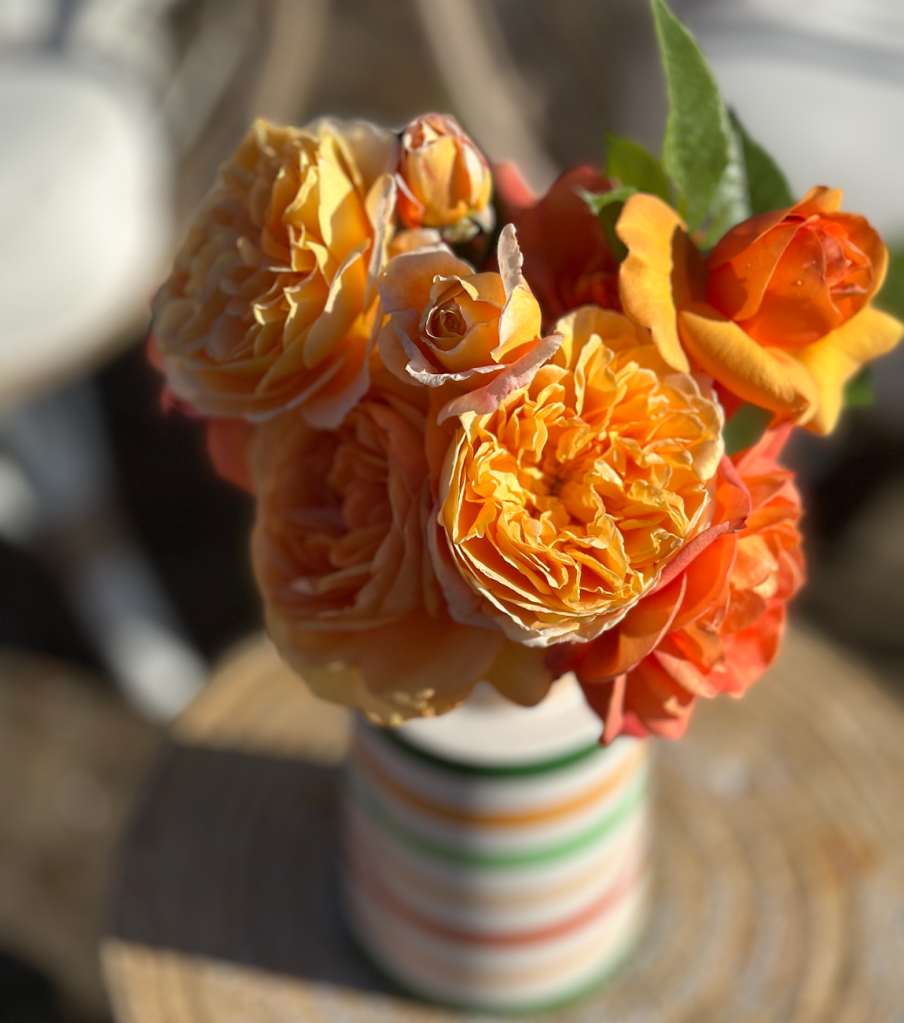
There’s a word I’ve been holding onto this fall – glimmer. It’s not the flash of lightning or the bold brilliance of a summer bloom. No, glimmer is smaller, quieter, and far more important. It’s that soft light that catches my attention for just a moment. It is the shimmer on a spider web after rain, the hum of a bee that refuses to give up on the fading cosmos, the way the air smells like wet earth and slugs.
But lately, Gerald the gnome and I have been struggling to find it.
Gerald insists it’s because of the weeds. He’s been particularly cross about the dandelions in the path and the creeping buttercup that continues its march into winter. He keeps muttering that no self-respecting garden should let the strawberries overtake the lavender and salvia like a berry-scented coup. And honestly, he may have a point.
I’m not much better. I tell myself to sit in the egg chair, to breathe in the soft fog of an October morning, to just be. But the minute I do, I spot another weed. Another vine creeping where it doesn’t belong. The perfectionist in me cannot stay still. I pop up, pull, trim, mutter. The “wildling” garden I claim to love just feels… messy. Overrun. Imperfect.
And so the glimmer hides.
The truth is, the garden doesn’t ask for perfection. It only asks for presence. The weeds aren’t an indictment of neglect; they’re proof of life persisting.
How many times in life do I do this? How many times do I focus on the thorns and the fungus instead of the rose?
How often do I let my focus slip from the beauty to the blemish, from the zinnia still standing proud to the one curling brown at the edges? I see the imperfection first. The flaw. The annoyance. The noise.
Maybe it’s human nature, or maybe it’s habit, this relentless seeking of what’s wrong. The garden, after all, mirrors me. It grows wild and beautiful, but never without struggle. And like me, it must weather pests and mildew and that never-ending feeling that it could be just a little better if only I worked harder.
But the glimmer asks something else of me. It asks me to pause. To look closer. To see not what’s missing, but what remains.
The glimmer doesn’t erase the imperfections. It shines through them.
So today, I will sit, even if only for a few minutes, and let the garden be what it is: overgrown, spotted, buzzing, alive. I’ll look for the small light that catches my breath and reminds me why I garden at all.
Because the weeds and the worries will always rise to the top.
But so, too, will the glimmer.


