
February 2nd, 2026
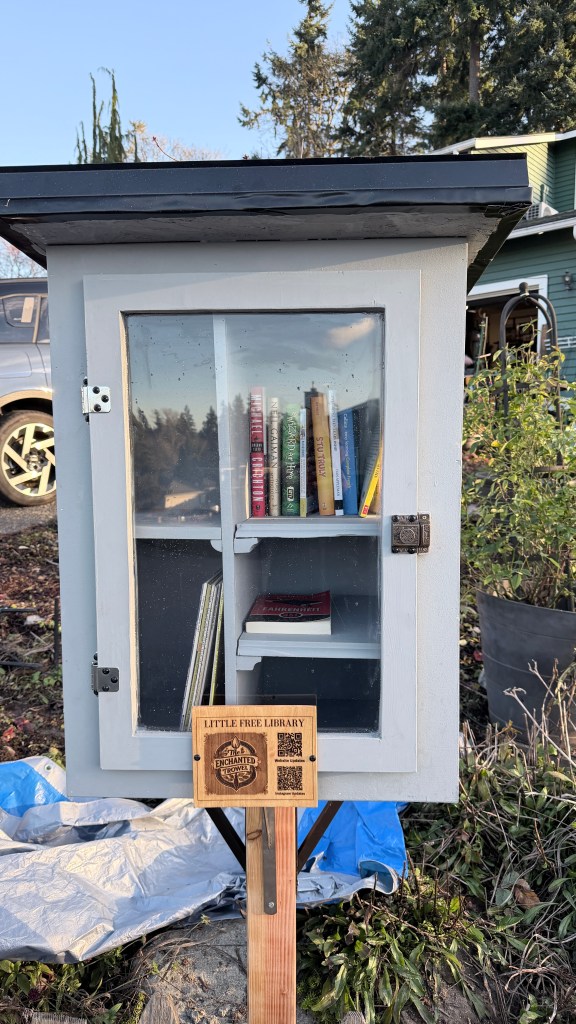
Building of the (not so) little free library…
So – several years ago I promised to build a little free library… I kinda didn’t get to it, until recently.
I came home one day to a stack of, ironically, library books about all the different ways and styles of little (and not so little) free libraries.
Browsing thru the options, I found a baseline of a template that could be modified for some custom requests:
- Living roof
- Rotating sections of books, vinyl, gifts, children’s books, etc
- A shelf to give away extra plant starts
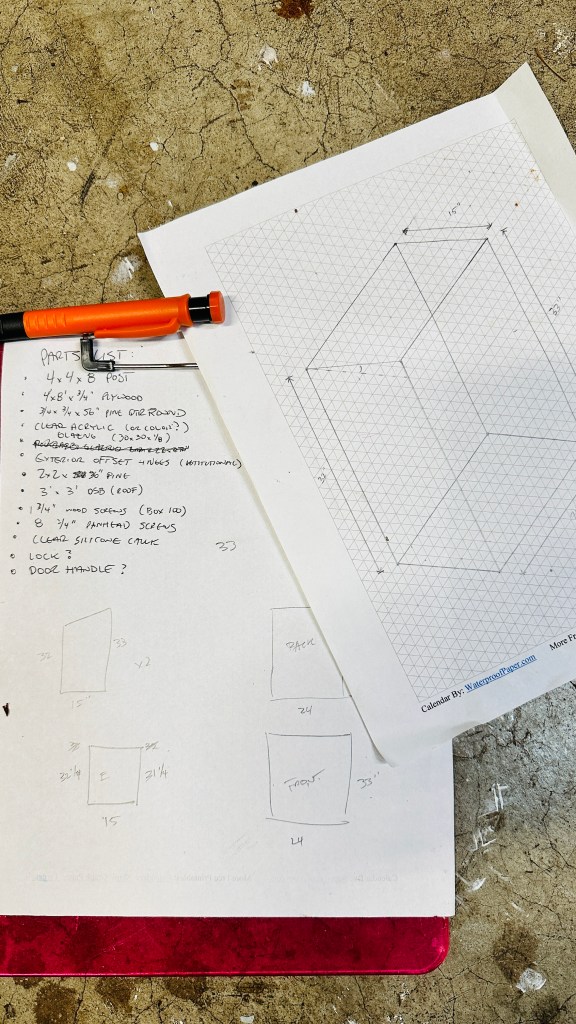
So, with the expanded design scope, it was time to break out the isometric paper, the scaled engineering ruler, and the HP48GX emulator on the phone.
The challenge… how to make a structure that can survive the wide range of conditions during a Seattle year.
Well, and make it affordable, no rare Brazillian hardwood here…
I figured I could get by with one 4″x8″ sheet of maple plywood, and same size OSB for the roof (would. be nice if they made a 4×4 sheet of OSB, just saying)…
Grabbed some 1/8″ acrylic for the windows and used some extra wood I had lying around for shelves.
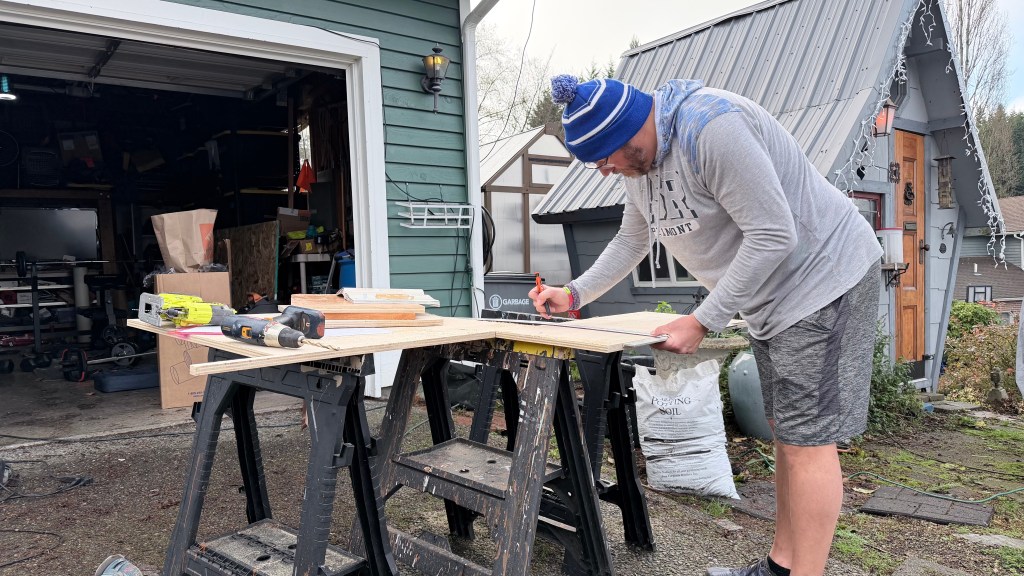
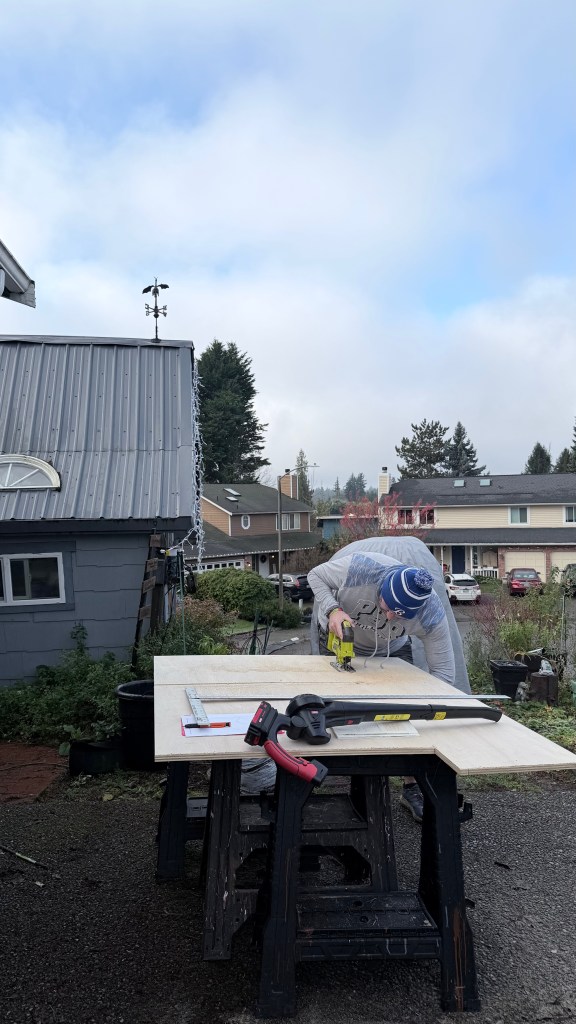
And then one day it happened, it stopped raining for a couple days so I could work on making the cuts outside.
Now, I hate my table saw… I wish I had one of those big industrial tables… but I mananged to make the master cuts before attacking with the jigaw.
Yes, that it blue sky, we had a few really nice days in January…
I managed to get all the cuts made, and sanded and then, oh boy, time for my new most favorite tool…
The hand planer – it’s just glorious…
Bad lines cutting with a jigsaw? Let Mr. Planer flatten it out smooth.
Then it was time to break out the finishing nail gun and screwdriver and start assembly. Everything came together very nicely, I then caulked all the seams with a clear outdoor grade silicone.
The Mrs. was kind enough to paint while I took a day to go skiing with the youngest. Installed the acrylic windows, shelving, and door frame and a big 4″x4″ fencepost brace on the bottom. Got to dig a nice big hole in the garden and stuck in a post and let it set.
Well, one little oversight – my post was a bit too tall… but thanks to Mr. RipSaw, that’s wasn’t a problem for long…
Used some heavy duty braces to reinforce the library on the post and BAM, library task complete.
The Mrs. had some cute ideas for signage and then she started loading for use.
Oh – the roof… I had a good idea for the living roof…
On top of the OSB, I put a layer of 1/4″ acrylic with the sides taped down with heavy duty waterproof roof tape. Used some flashing to make a lightweight box, caulked the corners, and added some small drain holes on the backside to prevent pooling.
November 11, 2025
Adventures in Carbonation
Sometimes you must admit the hard truth, we have a sparkling water addiction. For years and years, I’ve fought with canisters of SodaStream, always empty small bottles, and time spent endlessly refilling water…
One day on the way to an event, we had some time to kill so we stopped by the beer supply store in Kenmore with an idea in my head about making my own sparkling water dispenser…

Now, if you look online – wowzers, they are expensive. Home units run from $2500 and up. That’s hard to justify… so I thought, CO2 + water, how hard can this be?
So, we entered the store and talked to the fella inside about my idea. Sure enough, it’s not that hard to do – if you had the right parts and supplies!
First, the kegerator – this is a fancy college dorm fridge with holes for running pressure tubing and a beer tap. But… and here’s the fun part… a kegerator can store THREE 1/6 (sixer) kegs. One for water, and, yay, two others for beer!
But you say, aren’t those at different pressures? Yes, you are correct – sparking water is 35-40psi, while beer is 10-12psi. Hmmm, so what do you do? Multiple regulators!
Off the main CO2 tank, you use a dual regulator split each set to the correct pressure. Run those lines into the kegerator (seal the gaps!) and then use a splitter to run the 10-12psi line to each beer keg.
The beer kegs can use a standard commercial head, but the water is a little different. You’ll need a torpedo tank and this cool center pressure device with a stone on it that helps diffuse the C02 into the water faster.
Ok, run all the lines, make sure there aren’t any leaks and then wire up the 3 head tap on top… Ugg, could they make the opening any smaller to get a wrench in to tighten?
A trip to the local grocery store for 5 gallons of spring water and funnel into the torpedo tank, and a trip to Black Raven brewery for a couple of kegs (Men’s Room Lager, Mexican Lime Lager) and we are ready to rock and roll.
It takes the water about 6-8 hours to fully carbonate and get cold and we are ready!
Sparkling water on demand! Oh, and beer too.
Cheers!
From the Workbench of Dave the Builder: The Great Deck Debacle
It wasn’t my fault.
That’s what I keep telling myself anyway. See, I’m from West Texas, a land where the rain is more rumor than reality, where wood stays dry, straight, and cooperative. Out here in the Pacific Northwest, though? Everything swells like a biscuit in gravy. Deck boards included.
When we bought this house, it was the deck that sold me. Six hundred and sixty glorious square feet of cedar-planked perfection. It wrapped around the back like a hug, begging for summer evenings and good whiskey. Sure, the place needed work; there was fruit wallpaper straight from the 1980’s, wall heaters that were both a fire hazard and costly, and floors so layered in plastic linoleum you could ice skate from room to room. But that deck? That was the dream. Even if it overlooked a basketball court that nobody thought to level before they poured it.
Eventually, time came calling. The boards were soft in places, the nails popped like corn, and paying someone to fix it would’ve cost more than I paid for my first car. So I did what any reasonable man with misplaced confidence does – I headed to Home Depot.
Now, if you’ve never picked deck boards with a gardener watching, let me tell you: it’s a test of patience. Hers, not mine. Every board I selected was lifted, squinted at, sighted down the edge, and deemed “too warped” or “too knotted.” We spent an hour in that aisle, her muttering something about character in the wood and me insisting that “straight and true” meant something in this household.
Then the real work began. Backbreaking, finger-splitting, sweat-drenched kind of work. There were one… two… twelve… twenty-four total trips to Home Depot. Some of the joists were rotted. Some of the screws vanished into the abyss. But by the end of the season, I stood there, aching and proud, looking out over a sea of freshly laid cedar.
I’d done it.
And then winter came.
When spring rolled back around, I stepped outside with my coffee and stopped dead. Six hundred and sixty square feet of cedar that looked… tighter. A lot tighter. The boards, which had fit perfectly in September, had swelled over the winter until there wasn’t a gap left to drain a drop of rainwater.
Mr. Carson, the frog butler, stood on the railing and regarded me with the kind of judgment only amphibians can muster. My wife, the Gardener, poured a glass of wine, took one long look, and sighed the sigh of someone who knows she’ll now be painting and staining this deck every single year until the end of time.
Even Gerald the grumpy garden gnome softened. He threw a little ceramic arm over my shoulder and said, “Better luck next time, builder,” before Mildred sniffled and shuffled off toward the hydrangeas.
But I learned. Oh, I learned.
Next time, I’ll research. I’ll read. I’ll watch the YouTubes. I’ll even listen to the Gardener when she talks about “proper spacing.” Because that’s what you do when you build a life, and a deck, in a place where the rain doesn’t quit.
And wouldn’t you know it… it’s time again.
Time to replace the deck.
This time, the lessons learned will be put to good use: the gaps will be right, the boards sealed, the drainage proper. The frog butler will have nothing to judge. The Gardener might even raise a glass in approval.
Because if there’s one thing the rain teaches you, it’s patience. And if there’s one thing I’ve learned from this deck, it’s that even mistakes, especially the big, soggy ones, can lay the foundation for something better the second time around.

The Year of Hagrid’s Hut
By Dave the Builder
It all started, like a lot of my best (and most questionable) ideas do, over dinner – risotto and Pinot Grigio, anniversary number seventeen.
We were halfway through when I slid an envelope across the table. Inside were my plans for a little garden shed I was going to build for her myself. Just big enough for a few tools, a stack of pots, maybe a bucket or two. “A place for your stuff,” I told her, “so it stops living in the flower beds.”
She laughed, that good kind of laugh, and said it was perfect. And for about twelve hours, it was.
See, she’s not exactly… organized in the garden. Her trowels and snips migrate like geese. The good hoe? Always missing. Her favorite shovel? Half buried somewhere by the zinnias. I figured this shed would solve all that.
Simple plan. Small footprint. Whimsical but practical.
Then she found Instagram.
She swore she wasn’t looking for ideas – just “inspiration.” Next thing I know, she’s talking about round-shaped windows, porthole doors, Dutch doors (“for airflow,” she said), and copper handles. “What if it were just a little bigger?” she asked one night. “Just enough room to pot a plant or sit on a rainy day.”
And that, my friend, is how I knew I was in trouble.
So back to the drawing board I went. She went to Pinterest. A “smidge bigger” became “maybe add some shelving.” Then came talk of arched windows and fairy lights. Before I knew it, my weekend shed turned into a full-blown summer project.
We scavenged half of Seattle to build it – Second Use. She found an old corbel that looked like something out of a storybook, an antique door knob, and a “Ring the Bell” sign. I found a closet door that nearly ended our marriage, trying to make it fit as a front door. The wood swelled, the hinges creaked, but hey – real wood can always be sanded. Also, nothing fits through that door as it is tall and skinny.
There were a few… incidents. Once, the neighbor came running because he thought I’d knocked myself out with a beam (I hadn’t, though it looked bad). Another time, we tried to get an extension ladder up a sloped hill in the heat – let’s just say there was some “expressive language” and “colorful metaphors” used. Finally, I wised up and rented a scissor lift. Best decision of the project, also – so much fun.
Despite everything, it rose up there at the side of the yard – like something magical. She checked with the city about permits; no HOA to deal with, thank God. “Who wouldn’t want to see something so whimsical from the street?” she said.
Then she named it: Hagrid’s Hut.
The dragon-shaped weathervane on top? That’s Norbert.
By late summer, it was mostly done. The inside still needed shelves and hooks, but the bones were good. Whimsy had officially taken root.
Only problem? The tools still didn’t have a home. Because by then, it wasn’t really a shed anymore. It had become her dream hut. Sometimes a craft studio. Sometimes a tea nook. Sometimes just a place to sit and think. It eventually became storage for board games, puzzles, crafting supplies.
At some point, I knew: I had officially built a fairy tale.
She found fairy lights, curtains, an antique trunk, and two brass lamps that “matched perfectly.” I stopped asking questions. I just made sure the flooring had a vapor barrier and that we could move the whole thing someday if we needed to.
I built shelves strong enough to hold jars of buttons and seed packets. Didn’t complain when the potting bench turned into a Cricut station. Or when she planted a whole pollinator patch in front of it so she could watch hummingbirds from her egg chair at night.
The shovels live in the garage now when she doesn’t accidentally leave them on the hill.
And her heart? I think it finally found its spot too.
Those trowels, though – I guarantee they’re still out there somewhere. I’ll probably find them next spring. Maybe.
 The Enchanted Trowel