Book recommendations from the Pacific Northwest
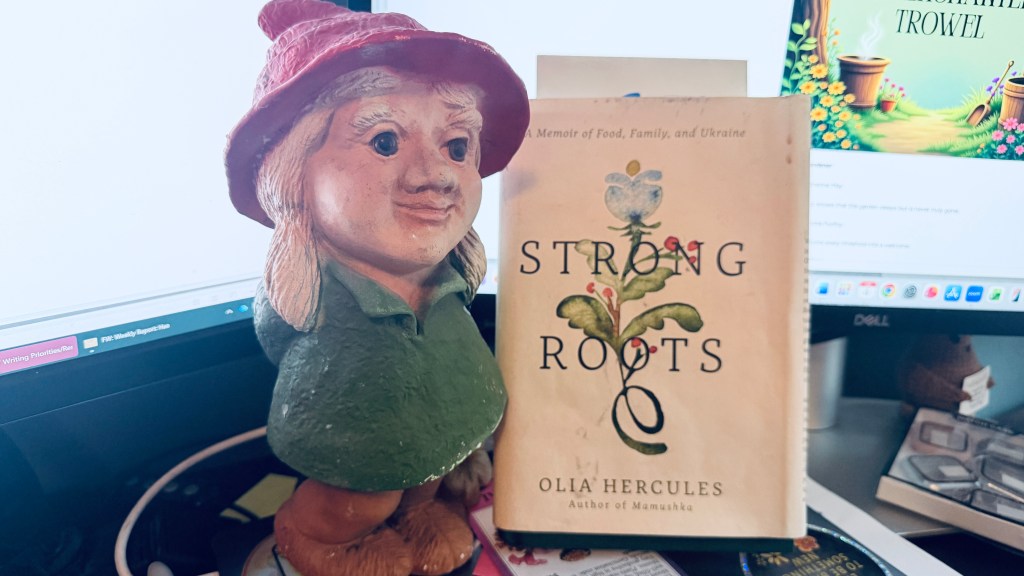
Strong Roots book review
Currently available in the Enchanted Trowel Little Free Library.
Book Review: Strong Roots: A Memoir of Food, Family, and Ukraine
I did not set out to buy a book about Ukraine.
I was wandering through an independent bookstore in Leavenworth, Washington, doing what readers do best, drifting, grazing, listening for a title to whisper. When I picked up Strong Roots: A Memoir of Food, Family, and Ukraine by Olia Hercules, I thought first of something I always tell my children: grow strong, deep roots so you don’t fall when the wind blows. Only later did I realize the book’s roots ran straight into a part of my own story that I rarely speak about.
My heritage is Russian Mennonite. Like many Mennonites, my family fled the Russian Empire in the late 1800s after losing their military exemption. In 1873, Mennonite delegations searched North America for fertile land, and eventually many settled across the plains of Kansas and beyond. We were ethnically German people who lived in what is now Ukraine, under Russian rule. Ukraine, as a modern nation, did not yet exist in the way we understand it today, and yet the soil, the kitchens, the language, and the customs shaped who our ancestors became.
Over time, much of that heritage faded in my family. My grandfather was a quiet Kansas rancher. I never knew my great-grandparents, and I never thought to ask my dad enough questions about our history. I regret that now. The one tradition my father held onto fiercely at the end of his life was pride in Ukraine. He flew a Ukrainian flag in front of his house until the day he died. As the war rages on, I’ve carried that forward, even while quietly wondering: Am I Ukrainian if Ukraine did not yet exist? Am I Russian? Am I German? Or am I simply someone shaped by all of it?
Strong Roots gave me a gentle way into exploring that question.
The memoir follows the author’s journey into her family’s Ukrainian past through food, memory, and travel. Rather than offering history as dates and borders, the book offers it as lived experience, through kitchens, markets, grandparents, and meals passed hand to hand. The story reminds us that culture is not abstract; it is tasted, smelled, cooked, argued over, and loved.
One line that stayed with me is when the author reflects that food becomes a kind of inheritance, a way to remember when stories disappear. She writes about how identity lives not just in documents, but in what families “carry to the table.” Another moment that resonated describes roots not as something fixed, but as something we keep uncovering, even when we thought they were gone.
What struck me most was how Strong Roots does not pretend heritage is simple. It allows space for contradiction, belonging to a place that has changed names, borders, and politics, while still belonging emotionally to the people who lived there. That felt familiar. My family’s Mennonite story is layered: Dutch and German Anabaptists, settlers in Prussia, farmers in Ukraine under the Russian Empire, refugees, Kansans, and now Americans. Somewhere along the way, the recipes thinned, the language vanished, and the questions went unasked.
My dad loved pickled beets and borscht. I hate them with intense passion, and not even nostalgia can convince me to introduce them to my own family. And yet, reading this book, I realized food is not just about taste, it’s about continuity. Even what we reject still marks us as belonging to something older than ourselves. After all, the borscht (and beets in general) is one of the only real cultural things that carried over into my father’s generation. Food is such an integral part of what makes a people.
Strong Roots offered me an unexpected connection to a part of myself that feels quietly lost. It reminded me that ancestry is not about claiming a nationality so much as honoring a story. Ukraine may not have existed as a nation when my ancestors lived there, but the land, the kitchens, the winters, and the fields existed. The people and the roots existed.
This memoir is gentle, reflective, and deeply human. It is for anyone who has ever wondered what happened to the traditions their family dropped along the way, or felt the ache of not asking enough questions while they still could. This is something I felt and mourned deeply when my dad passed away. The last trip I made with him was after my grandmother’s funeral, as we drove through the countryside with my dad explaining where the farmhouses of my grandparents and great-grandparents used to be. I saw the fields that must have looked like heaven to those fleeing. I paid attention, but I didn’t know that yet another loss was coming and more history would fall into the void.
In the end, Strong Roots doesn’t tell you who you are. It invites you to listen for where you come from, and maybe, finally, to grow into it. And, reading it made me realize that I carry more of that heritage than I realized. “A vegetable patch and an orchard are burnt into our country’s DNA, indelibly part of our cultural heritage.” Something my father created in our little plot of land in a suburb of Dallas, Texas and something I am creating in a suburb of Seattle, Washington. So, maybe the roots are stronger than we realize even when we don’t know what we are passing down.
Book Review: Five Stars, Highly Recommend.
Christy, The Gardener
Wintering by Katherine May
For the reader who: knows that the garden sleeps but is never truly gone.
Placemaker by Christie Purifoy
For the reader who: turns every threshold into a welcome.
Devotions by Mary Oliver
For the reader who: prays best with dirt beneath their nails.
Braiding Sweetgrass by Robin Wall Kimmerer
For the reader who: listens as much as they plant.
Anne of Green Gables by L.M. Montgomery
For the reader who: refuses to grow out of wonder.
The Silent Gondoliers by William Goldman
For the reader who: loves a touch of melancholy with their whimsy.
Inward: A Guide to Self-Mastery by Yung Pueblo
For the gardener who knows that we all need a little stillness.
Rhapsody in Green by Beverly Nichols
For the reader who: loves gardens that are wild, whimsical, and full of life.
You Better Be Lightning by Andrea Gibson
For the reader who: runs on heart, hope, and high-voltage energy.
Dave, The Builder
Dune by Frank Herbert
For consummate science fiction fan. Weird as hell, but what a read, may thy knife chip and shatter.
Project Hail Mary by Andy Wier
For hardcore science and space junkies, truly wonderful, go ahead and fist my bump
The Watchmen by Alan Moore
For non-marvel superhero fans about life in a bleak future, more naked blue dudes than you really need to see…
The Rising Tide / Steel Wave / No Less than Victory by Jeff Shaara
For history lovers who enjoy true events told with the richness and drama of a great story
Robopocalypse by Daniel H. Wilson
For the reader who wants a sneak peak into the future coming soon.
How to Teach Physics to your Dog by Chad Orzel
For the reader who wants to understand how the universe works, NOTE: despite my best efforts neither of the pups have been super responsive to my lessons.
Mr. Carson, the Frog Butler
The Elegance of the Hedgehog by Muriel Barbery
For the butler who: knows that brilliance often hides behind good manners.
The Complete Stories by Guy de Maupassant
For the reader who: enjoys a touch of cynicism with his aperitif.
Anna Karina: Une Vie à Part by Alain Jessua
For the reader who: is an admirer of the ineffable.
All Quiet on the Western Front by Erich Maria Remarque
For the reader who: enjoys an afternoon of melancholy.
Gerald, the Gnome
The Wind in the Willows by Kenneth Grahame
For the old soul who: appreciates proper manners, cozy burrows, and mild mischief.
The Secret Life of Trees by Peter Wohlleben
For the gnome who: pretends he’s unimpressed by “tree-hugging nonsense.”
The House in the Cerulean Sea by TJ Klune
For the reader who: believes the world has gotten far too sentimental.
Notes from a Small Island by Bill Bryson
For the gnome who: appreciates a well-crafted complaint.
Mildred, the Gnome
The Secret Garden by Frances Hodgson Burnett
For the gnome who: knows that healing often starts with soil under your fingernails.
The Guernsey Literary and Potato Peel Pie Society by Mary Ann Shaffer & Annie Barrows
For the reader who: loves letters, friendships, and slow-growing trust.
The Cottage Tales of Beatrix Potter by Susan Wittig Albert
For the gnome who: appreciates talking animals, sensible shoes, and well-ordered herb beds.
Still Meadow Seasons by Gladys Taber
For the gnome who: finds comfort in small domestic miracles.
Gandalf, the dog
The Art of Racing in the Rain by Garth Stein
For the philosopher pup who: feels things deeply.
The Hobbit by J.R.R. Tolkien
For the brave adventurer who: always ends up muddy but triumphant.
How to Be a Good Creature by Sy Montgomery
For the soulful dog who: believes humans are a bit slow to learn unconditional love.
Flora & Ulysses by Kate DiCamillo
For the hyperactive dog with a wizard’s name and a philosopher’s heart.
The Little Frog’s Guide to Self-Care
For the reader who: needs gentle reminders that naps, snacks, and walks are vital to happiness.
Charlie, the Elder
The Sound of a Wild Snail Eating by Elisabeth Tova Bailey
For the reader who: loves something slow, observant, meditative
All Creatures Great and Small by James Herriot
For the pupply who: loves his stories a little muddy and chaotic
Goodnight, Moon by Margaret Wise Brown
For the old boy who: loves comfort in the simplicity.
 The Enchanted Trowel