What Kind of Connection Are You Making?
A Garden Meditation with Slugs
Lately, I’ve been thinking about connection, but not the kind that requires a password reset or a stronger Wi-Fi signal. The other kind. The one that pulls us toward each other, toward the soil, toward something holy and humming just beneath the surface.
I suspect most of us are seeking connection in one way or another. With fellow human beings, our communities, and nature. With the dirt under our fingernails. With God. With something that assures us we are not alone in this often wide and sometimes wobbly world.
There is a book that I saw while visiting Powell’s Bookstore in Portland called: How to Raise a Plant and Make It Love You Back by Morgan Doane. I haven’t read it yet. Perhaps I am saving it like one saves the last packet of sweet pea seeds. I love the premise because it assumes a reciprocal relationship.
But what if there were another book called:
What Kind of Connections Are You Making? And Why?
That one might be harder to read.
Recently, I was serving communion at church. I looked each person in the eye and said, “The body of Christ, given for you.” Some looked directly into my eyes, and some didn’t. In either case, it was a connection.
It was a human connection, a connection with the Holy Spirit. It was a fragile, fleeting, powerful moment of shared presence that was simply offered and received.
In this particular season of turmoil, where arguments bloom faster than zinnias in July, I sometimes wonder if we are confusing connection with conquest. We gather online to be right, to spread a message, and to win.
But is that fruitful?
Is the connection we seek open and honest? Is it curious? Is it generous? Or is it a kind of echo chamber trellis, built only to support what we already believe? Winning can feel like the whole point. But winning rarely grows tomatoes.
In the garden, connection is rarely about domination (well… unless you are in active combat with bindweed, but that is for another day). Mostly, it is about the give and take of tending.
We do not shout at the peas for failing to germinate. We do not post strongly worded manifestos at the hydrangeas or shake our fists at the sky when the aphids try to eat the dahlias. We plant, we water, we observe, and we adjust.
As Thomas Moore said, “The garden reconciles human art and wild nature, hard work and deep pleasure, spiritual practice and the material world. It is a magical place because it is not divided.”
That reconciliation is not automatic. It comes with practice, which requires both thought and patience. You cannot plant a seed and ignore it. Well, you can, but you shouldn’t expect great results.
Plants must be tended day in and day out. In a world where it sometimes feels like everything is a trend, where we scroll past outrage as if it were a clearance rack, we are forgetting how to do the daily tending in ourselves.
Mildred, who worries incessantly, wrung her tiny felt cap between her hands this morning.
“We are losing the art,” she said. “People don’t sit long enough to know their own soil. They just fling seeds of opinion and expect applause.”
Gerald, more forlorn by temperament, sighed deeply from his overturned clay pot.
“The art is already lost,” he declared. “We are all shouting at tomatoes.”
I, on a good day, disagree.
I believe that we still long for community. I believe we are still willing to do the work of tending. I believe that, even now, most of us would rather grow something than scorch it.
Which brings me to the underbelly of connection.
I was weeding the strawberry bed when I overheard a rather philosophical exchange beneath the mulch.
The slug was the first to speak.
“We are misunderstood,” he said, stretching languidly across a tender leaf. “I am merely seeking connection.”
“With my hostas?” I muttered.
The snail adjusted his shell with quiet dignity. “Connection requires patience,” he said. “I carry my home. I do not rush. I leave a trail, yes, but it glistens.”
The worm surfaced briefly, blinking in the light. “You two speak of surface matters. True connection happens underground.”
The slug scoffed. “Easy for you to say. You are literally hidden.”
The worm wriggled thoughtfully. “And yet, without me, the soil compacts. Roots cannot breathe. Growth falters.”
The snail nodded. “Perhaps connection is not consumption.”
The slug paused mid-chew.
The worm continued, “Connection is exchange. I aerate. The roots feed me sugars. The soil changes. We all participate.”
The snail added, “Even our trails alter the garden. We cannot move without leaving something behind.”
The slug sighed. “I suppose I could try nibbling less destructively.”
“That,” said the worm gently, “would be a start.”
I considered this as I plucked him and relocated him to the compost heap, a boundary, not a banishment.
Even in the garden, connection has edges. Not all interactions are equal or beneficial. The trick is not to eliminate conflict, but to cultivate fruitfulness.
Some connections feed the soil.
Some compact it.
Some glisten briefly in the sun and evaporate.
So, perhaps the question is not simply: Are you connected?
But: What kind of connection are you making? And why?
Is it rooted in curiosity?
In generosity?
In shared tending?
Or is it rooted in the need to conquer? To win? To prove?
The garden does not thrive on conquest. It thrives on attention, practice, and the slow reconciliation of opposites.
Human art and wild nature.
Hard work and deep pleasure.
Spiritual practice and the material world.
It is magical because it is not divided.
On my better days, I believe we can be like that too.
We can look one another in the eye and say, “Given for you.”
We can receive or not receive, and still belong.
We can argue without devouring.
We can disagree without scorching the soil.
We can tend.
Mildred is still worrying. Gerald is still sighing. The slug is under observation. The worm continues his quiet ministry beneath our feet, and the snail, well, he hasn’t gone far yet.
I am out here, planting seeds and cleaning out the greenhouse for another fruitful season, not because I am certain they will grow, but because connection, like gardening, is a practice.
And I still believe it is worth the daily work.
What Does it Mean to Live in Abundance?
I was sitting in a church meeting when my pastor talked about abundance.
Abundance, what a word.
Abundance is defined as:
A great or plentiful amount.
“An abundance of rain.”
The condition of being in rich supply.
“Tomatoes growing in abundance.”
A degree of plentifulness.
I think, in our society, abundance takes on different connotations. It often carries a materialistic component. Scroll Instagram long enough, and you’ll see it: Get ready with me featuring fifty skincare products. Reset my house with me as someone straightens a house already so clean you could lick the countertops, while they dust their perfectly beige, 3,500-square-foot home full of all the must-have items, matching cookware, large television, etc.
What is abundance really? Is it a negative? No, not really. With abundance comes ability; the ability to share, to gift, to do, to be present.
The Gardener wants an abundant garden so she can share both plants and produce. Abundant energy means you can show up in the world.
Mildred the gnome sat down as I wrote this and noted that gnomes don’t think of abundance as more. They think of it as enough, noticed.
To a gnome, abundance isn’t a bursting pantry or a garden flexing its muscles. Gerald grumbled a bit when Mildred called him over. He noted that he is suspicious of hoarding. Piling things up makes you stop seeing them. A gnome would rather have three tomatoes admired than thirty ignored.
Gnomes also believe abundance moves. If you clutch it, it sulks. If you share it, it multiplies. That’s why gnomes leave extra berries for birds, compost their mistakes, and celebrate small wins like they’re harvest festivals.
One good carrot that tastes like sunshine.
Abundance.
To me, it is Mary Oliver, my favorite poet, who says, “Pay attention. Be astonished. Tell about it.”
Abundance is around us all the time. It isn’t a thing or things. It isn’t possessions. It is the ability to notice when you have enough, are enough, and are living intentionally enough.
Appreciating abundance is almost an act of resistance, for it is not what we are told we are to want in this world. So, let us resist and be astonished by……abundance.
Are you living into your abundance? What does that look like for you?

On Fences, Roots, and the Courage to Belong
January 9, 2026
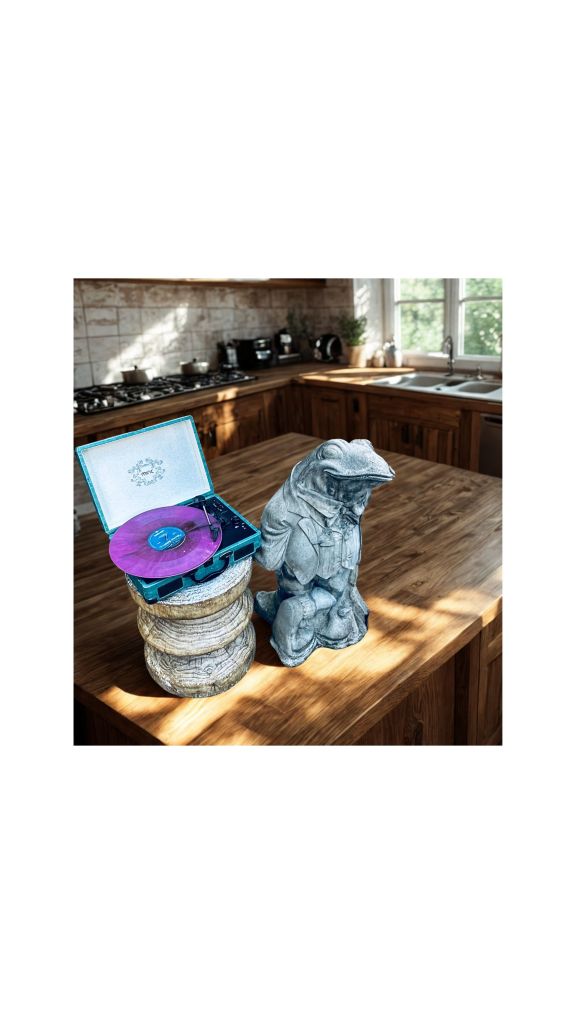
Mr. Carson, Garden Statute & Steward, Gentleman Amphibian, and Occasional Philosopher
I stand, as I always do, at my post on the back deck, umbrella in hand, coat forever proper, eyes cast toward the damp and thoughtful corners of the garden. The rain has been courteous today. Not absent, mind you, rain never truly leaves the Pacific Northwest, but soft, as if it knows better than to interrupt a good contemplation. It has been a hard winter in the Pacific Northwest. So much rain…. causing untold loss and trauma as houses flood and roads wash away.
Watching it all from my deck, where I have the benefit of a fine view of the fence and an elevated platform protecting me from pooling water, I can see so clearly.
It is a respectable fence. Weathered cedar. Moss in the seams. Built with intention, and a certain human confidence that says, Here. This is where one thing ends, and another begins. Humans seem to find comfort in such lines.
The roots, however, do not.
Below the soil, our shared, dark, generous soil, roots pass freely beneath that fence. The sword fern does not pause to consult a surveyor. The salal does not ask if it is welcome on the other side. The English Ivy that The Gardner is constantly battling doesn’t seem to mind that she doesn’t want it climbing up the deck walls.
I have watched this for years, which is what one does when one is a concrete frog butler with an umbrella and a great deal of time to think.
Roots understand something humans often forget: the soil does not belong to anyone. It holds everyone.
In this garden, nourishment moves by quiet agreement. Fungi whisper between roots, passing messages and minerals. One plant struggling in shade is steadied by another basking in brief, rare sun. The ecosystem thrives not because everything stays in its own tidy place, but because it doesn’t. Because life is generous with itself.
Humans, I’ve noticed, grow anxious at crossings. Lines on maps. Names on gates. Papers, permissions, and fences taller than they need to be. There is much talk of who belongs where, and who does not. I find this puzzling, considering how thoroughly entangled everyone already is.
Rain that falls on one roof runs into another yard. Wind carries seeds far from the hands that planted them. Pollinators, bold, fuzzy diplomats, cross every border without a passport, asking only that there be something blooming when they arrive.
Belonging, in the garden, is not granted. It is practiced.
I Rage and I Pray
I rage and I pray,
I pray and I rage,
as my brothers and sisters in Christ
are under attack.
As those who speak out are hunted,
and the people are beaten,
I rage and I pray,
I pray and I rage.
For a world that I no longer recognize,
for a place that no longer feels like home.
I pray and have faith,
I have faith and I pray,
that this moment is only a moment in time,
soon replaced by another
One where we can garden and smile,
and smile and garden,
free from tyranny,
free from chaos,
Where brothers and sisters in Christ are safe,
where humanity prevails,
where cruelty fades,
and tyranny dies.
Still,
I pray and I rage,
I rage and I pray,
holding hope in trembling hands
until light returns again.
Dec 2nd, 2025
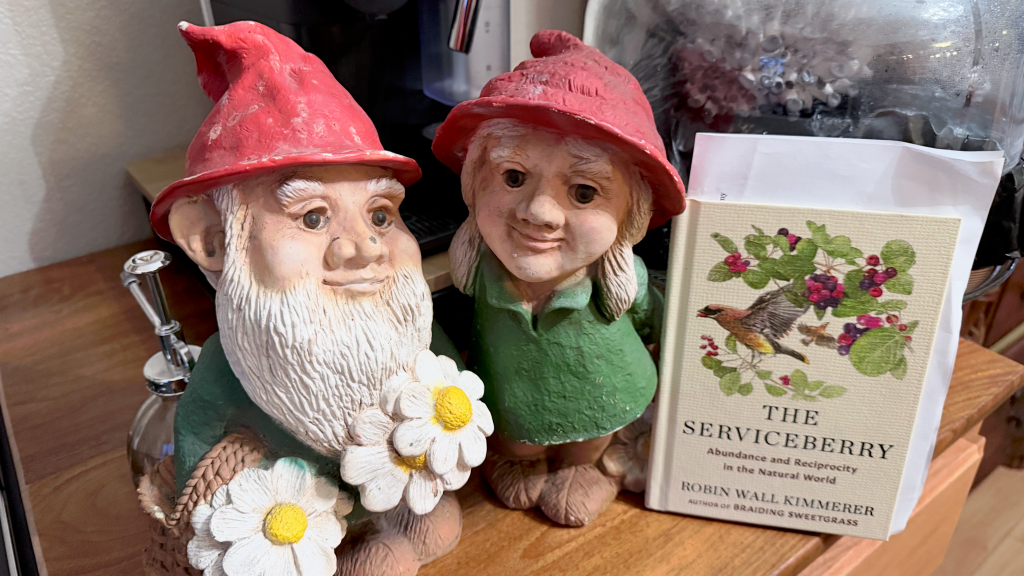
Seeing With Serviceberry Eyes
This week, as I reread Robin Wall Kimmerer’s Serviceberry, I found myself lingering on one of the central teachings she returns to again and again: the idea that gifts, whether from the land or from one another, tie us into relationship, not transaction. The serviceberry doesn’t simply feed us; it invites us into reciprocity. It asks us not only to receive but to give back, to care for what cares for us.
Kimmerer reflects that a gift calls forth responsibility, and that living well means entering into a cycle of mutual nourishment. Her words nudged me in that quiet, unsettling way good wisdom often does, making me ask: Do I do this often enough in my own life?
I am blessed beyond measure to live in webs of community. This includes family, Scouts, church, neighborhood, and the circles of helpers that always seem to spring up when something needs tending. These people create, raise, fix, carry, guide, and comfort. They take the high road when it’s rocky. They work silently so others can shine. They absorb more than their fair share. They keep our little worlds moving.
But even the strongest among them must get weary.
Kimmerer writes that the serviceberry teaches us not only about sweetness but also about responsibility to the ones who sustain us. She describes how the plant thrives because generations before us tended it, cared for the soil around it, and passed on the knowledge of how to help it flourish. Reciprocity is not charity. Instead, it is honoring a relationship.
It made me wonder: Do we, as a society, provide soft landing places for the ones who do so much?Do I?
As I head into my own “season of wintering,” I’ve decided this will be my intention. Not a grand, sweeping resolution, but a daily practice. To take a few minutes each day, or each week if that’s what life allows, and truly look around. To notice who is quietly carrying weight. To see the groundworkers, the caretakers, the toilers, the bridge builders.
To have eyes of gratitude, but not silent gratitude.
I want to uplift where I can. To thank more freely. To offer help without waiting to be asked. To practice the kind of gentle reciprocity Kimmerer describes: the kind that builds community rather than extracts from it.
Because if the serviceberry teaches us anything, it’s that sweetness grows where care flows both ways. And that we are always, always part of a larger circle.
Reflections from a Frog Named Mr. Carson
by Mr. Carson, Garden Statute & Steward, Gentleman Amphibian, and Occasional Philosopher
This morning began, as many do, with the polite tap-tap of dew on the roof of my watering can. I emerged from my home, a deck in need of repair, and opened my umbrella, more from habit than necessity. One likes to maintain appearances.
From my vantage point next to a rose bush in a pot and an empty deck planter, I took stock of the garden. A fine chaos, as always. A proper English garden aims for restraint, control, and the symmetry of roses in obedient rows. But here in the Pacific Northwest, we are ruled by rain, mushrooms, and rampant blackberries. An uncultivated democracy, you might say.
The new, no-spill bird feeder was already in full uproar. Chickadees bickering like Parliamentarians, juncos darting in and out with passive-aggressive efficiency. But the real trouble was the hummingbird.
He’s no bigger than a thimble, but he zips in like an air raid, dive-bombing anything that dares approach the nectar. I’ve seen him chase a blue jay clean across the property line. He is small, yes, but tyrannical. One can be both, you know. His favorite spot is on top of Norbert the dragon, as though a hummingbird can conquer a fire-breathing beast. It’s rather astonishing how much control one can exert when fueled by sugar and rage.
Now, I am not a despot. I say this plainly, for one must be clear these days. Being a butler is not the same as being a tyrant. I do not dictate. I serve. I observe. I make tea when required. I do not demand that the garden conform to my ideals.
And yet, how tempting it is.
I watched the rodents of unusual size (ROUSes, if you’re of a literary bent) slink through the ferns. They come at dusk, their movements as sleek as secrets. The bunnies, too, with their soft rebellions under the fence. Dave reinforced it thrice, and thrice they proved him foolish. The raccoon ambled by like a man late to his own party. Before I could issue a disapproving croak, Gandalf the Wise (the garden’s unofficial Lord, entirely self-appointed) leaped from the shadows. The raccoon vanished, muttering indignantly.
And what, I ask, is the moral here? The point of this blog?
There is none.
That is the very point.
Humans, good grief, I do like you, but you do adore being right. You fashion your little worlds around certainty and control. Your politics, your laws, your lawn edges. But the garden? The garden cares not for your narratives.
Here, things happen. The lettuce bolts. The squirrels defy gravity. The soil swells with mushrooms you neither planted nor understand. Predators prowl. The aphids arrive, and they do NOT stick to attacking the nasturtium as you requested. You can stomp and spray and shout about invasives and pests and who belongs where, but the garden only shrugs. It knows better.
There is no black and white in the garden. No good and evil. Just interaction. Consequence. Balance, sometimes. Mess, always.
Even the bully of a hummingbird has his place, infuriating though he is.
When people speak of control, they often miss its roots: domination, certainty, the insistence that one way, your way, is the right and only way. The hummingbird thinks this. The raccoon does not. The garden certainly knows better.
To be in the garden is to remember the Circle. Life consumes and is consumed. Growth is made of death. You are not the master here; you are part of it. A temporary guest with muddy boots and a full heart.
So I sit, umbrella tilted just so, and watch the whole lovely mess unfold.
No villains. No saints. Just beings.
And I, Mr. Carson, frog butler, am at peace with the chaos.

 The Enchanted Trowel