
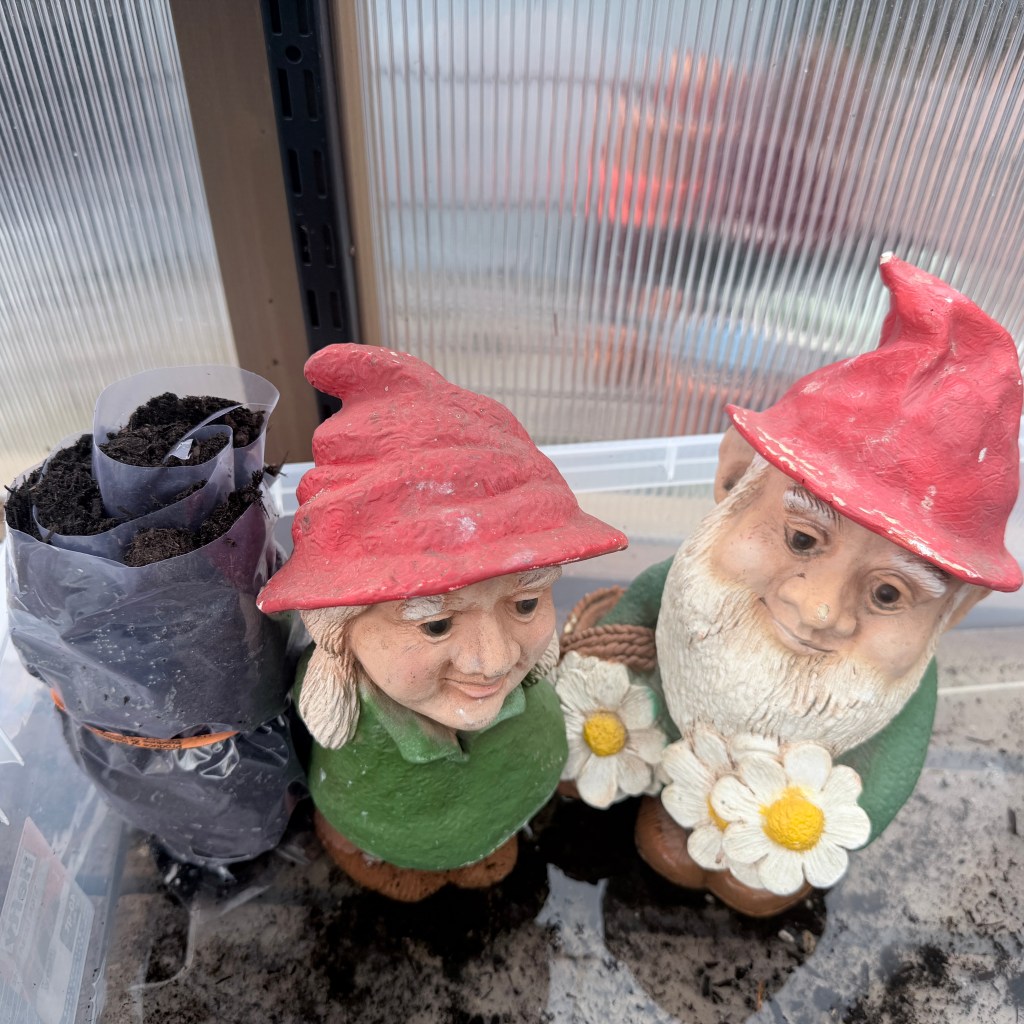
The Year of the Snail (According to Mildred)
Every year, there is a garden trend. One year, it was winter sowing in milk jugs, which left entire neighborhoods rinsing out dairy containers like we were preparing for a recycling pageant. Then came chaos gardening, which, in theory, means “naturalistic abundance” and, in practice, means Gerald is still pulling out volunteer forget-me-nots from every bed in the garden.
This year?
Apparently, if my feeds are to be believed, it is The Snail. Not the mollusk, but the seed starting method. Mildred discovered it on TikTok..
The Snail Method, Explained (While Tea Is Being Sipped)
The snail method (also called a soil roll) works like this:
You lay down a strip of plastic and spread a thin layer of potting soil. You place your seeds carefully along one edge and then you roll the whole thing up like a cinnamon roll of botanical ambition. Finally, you stand it upright in a tray, water it from below and watch it grow! Easy, peasy!
It takes up very little space, which is precisely my problem.
Mildred (perched at my desk, scrolling):
“You could start so many more seeds this way.”
Gerald (from somewhere behind the desk where he got bumped.
“She already starts too many.”
The Gardener (me, pretending to label things responsibly):
“It’s for science.”
Gerald:
“That’s what you said before the Chaos Zinnia Incident.”
Mildred:
“Oh hush, Gerald. Think of the efficiency! The verticality! The innovation!”
Gerald:
“I’m still cleaning out forget-me-nots from 2024’s ‘innovation.’”
Here is my situation:
I have a garage and two greenhouses – the good one with a heater (The Enchanted Trowel Greenhouse) and the older, plastic one that can only handle colder-weather items like lettuce and peas. I already possess the capacity to start more seedlings than my modest garden could ever reasonably contain.
The current system works beautifully:
- Seed trays
- Bottom watering (ish)
- Heat mats for warm crops
- Grow lights
- Labels (sometimes accurate)
The snail method does not solve a space problem for me, but it creates a self-control problem. If something takes up less room, my heart whispers:
“We could start 3,000,000 seeds.”
And my head (and Gerald) replies:
“We have 1,200 square feet of actual planting space.”
So, the snail method is clever, efficient, and tidy. Seedlings grow downward in the spiral. Roots follow gravity. When it’s time, you unroll it and separate them for potting up.
It’s especially good for:
- Tomatoes
- Peppers
- Lettuce
- Snapdragons
- Small seeds that are fiddly in trays
Less ideal for:
- Big seeds (peas, beans, sunflowers)
- Taproot plants
- Gardeners prone to overenthusiasm (We know who we are.)
Am I going to try it? Of course! I am preparing to teach youth about plant sciences. And for that purpose? One snail is brilliant.
We can compare:
- Germination rates
- Root growth
- Moisture retention
- Transplant success
- Space efficiency
We can observe gravitropism in real time. We can measure root length at Day 14 and gather data. Mildred loves data when it supports her. Gerald loves data when it proves restraint.
In our class, we can also all create snails and take them home for further analysis.
So here is The Gardener’s 2026 rule: One snail. Twenty to thirty seeds. For science and not for mass production. Not for turning the greenhouse into a rolled-up botanical lasagna factory.
Mildred (triumphant):
“You’ll see. It’s the future.”
Gerald (arms crossed):
“The future still has weeding.”
The Gardener:
“We are conducting a controlled experiment.”
Mildred:
“With zinnias?”
The Gardener:
“Maybe snapdragons.”
Gerald:
“If this ends with another self-seeding situation—”
The Gardener:
“It will not.”
(We all know it might.)
How are you starting seeds this year?
Are you a:
- Tray Gardener
- Soil blocker?
- Milk jug winter sower?
- Chaos enthusiast?
- Secret snail roller?
Update: Okay – I, The Gardener, may refer to my first attempt as a seed slug instead of a seed snail. It is too tall and very, very messy. I am not convinced about this method, but I planted King Size Red Strawflowers. Will let you know if it actually works.
There will be data because The Builder loves data. My second attempt will involve snapdragons and a smaller snail.
RIP Mindy the Mushroom – Composted Feb. 16, 2026. The Gardener’s one and only attempt at mushroom farming has ended.

January 20, 2026
Gardening: Trusting Weird Living Things That Refuse To Follow Your Plans
By Christy, The Gardener
Of all the confessions one can make in the Pacific Northwest, “I accidentally resurrected a mushroom” feels… on brand.
When I proclaimed, with great ceremony and a damp Kleenex, that this would be the last post about Mindy the Mushroom (RIP), I lied.
Not on purpose.
Not maliciously.
Not in the way villains lie.
I lied the way gardeners lie: with feelings first and facts later.
I wrote a meaningful blog post about expectation, disappointment, and letting go. Then I placed Mindy on the counter “just for a minute” while I planned to Google whether she belonged in the worm compost, the regular compost, or the yard waste bin.
That minute became a week.
Life happened. Coffee happened. Other plants demanded attention. Gerald adjusted his gnome hat. Mildred alphabetized her seed packets. And Mindy… just sat there.
Then one day, I reached for her to finally complete the farewell tour.
And she was alive.
Not thriving.
Not perky.
But… producing.
Lethargic, yes.
Dramatic, absolutely.
But undeniably still in the game.
I repeat: not dead yet.
There are few things more humbling than emotionally eulogizing something that then refuses to cooperate with your narrative. There she was, quietly fruiting like, “Excuse me, I am still booked for this season.”
So what does this say about expectation?
Apparently, I am very good at deciding the ending before the story finishes.
Maybe this isn’t a post about expectation after all.
Maybe it’s about hope.
Or not giving up too early.
Or how gardening is basically just trusting weird living things that refuse to follow your plans.
Or maybe it’s simpler:
Gardens are full of surprises.
And sometimes the surprise is that your dead mushroom has a plot twist.
I considered calling the post “There Is Still Fungus Among Us.”
Because, honestly, the opportunity was right there.
When I told Gerald, he just shrugged and kept pruning. He had his headphones in and was listening to Evermore again, which feels appropriate for a mushroom that simply will not go quietly. He didn’t even pause his snipping. Just a little nod like, “Of course she lived.”
Mildred, however, sat down for tea and began what I assume was a lecture. I didn’t have the energy to fully listen, but I caught phrases like “reckless harvesting,” “emotional overreactions,” and something about me nearly offing her favorite mushroom. She stirred her cup aggressively.
So instead of another essay, I offer you this:
A poem.
For Mindy.
Still here.
Still weird.
Still teaching me things I didn’t ask to learn.
Ode to Mindy, Who Refused to Die
I mourned you once with soggy prose,
Declared your season done,
I wiped my eyes, I sighed real big,
Your chapter overrun.
You sat upon my kitchen counter,
Week-long in quiet decay,
While I debated bins and futures
And forgot you, day by day.
But lo
You bloomed in soft rebellion,
A fungal little grin,
Producing in defiance,
Like, “Ma’am, I’m still all in.”
Not lively.
Not majestic.
But stubborn in your way,
A mushroom whispering gently,
“It ain’t my dying day.”
So teach me, Mindy Mushroom,
Of endings done too fast,
Of gardeners who write goodbye
Before the present’s past.
For hope is sometimes sluggish,
And miracles look small,
And life keeps doing sneaky things
When we think it’s done with all.
So grow, you countertop warrior,
You odd and silent friend,
Proof that in the garden,
We don’t always choose the end.
RIP Mindy the Mushroom – A Discussion About Expectation
January 14, 2026
Mindy the Mushroom – December 15, 2025 – January 13, 2026
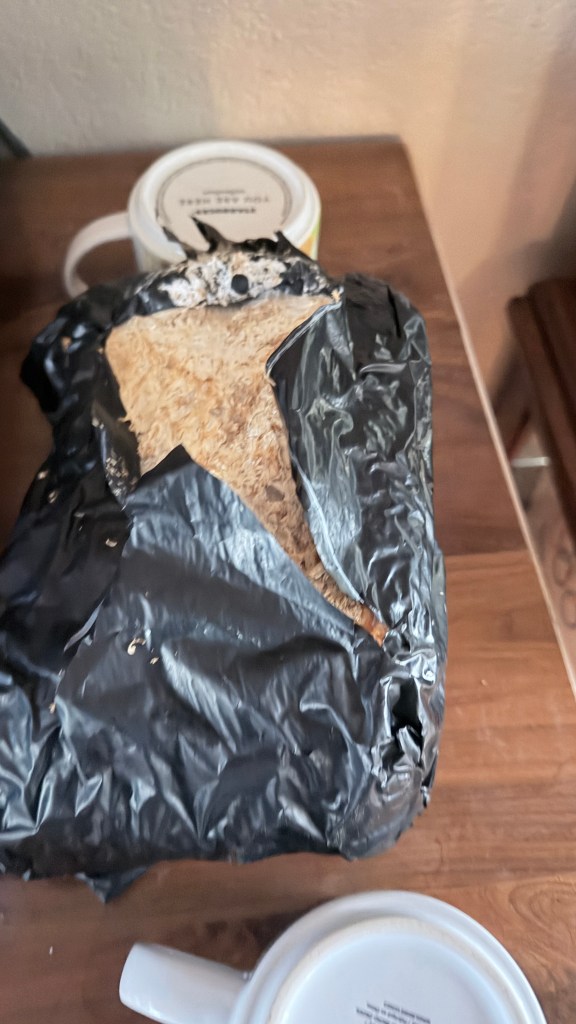
It is with a heavy heart (and an empty cake stand) that I must officially report: Mindy is dead.
Mindy the Mushroom, brief but beloved resident of the garden, was established in December of 2025 and departed this world on January 13, 2026. She lived fast, flushed hard, and left behind a surprisingly weighty philosophical lesson for something that never once needed watering exactly right (except that she absolutely did).
When I purchased the humble block that would become Mindy, the packaging was very clear, very reasonable, and very honest. If you are lucky, it said, you may get three flushes.
And I did.
Three.
The third was a bit bare bones, I’ll admit, more “minimalist art installation” than “bountiful harvest”, but in Mindy’s defense, she had just had a great trauma. Three flushes were the absolute best they told me to expect. I received precisely what was promised.
And yet.
I found myself terribly disappointed that Mindy did not overperform.
Gerald the Gnome, ever loyal and slightly dramatic, immediately sided with me. He muttered something about unrealized potential and unfair circumstances. But Mildred, wise, steady Mildred, slowly removed her reading glasses, fixed me with that look, and reminded me (as she is wont to do) while quoting Shakespeare:
“Oft expectation fails, and most oft there where most it promises; and oft it hits where hope is coldest, and despair most fits.”
Oof.
Why do we do this? Why do we begin with reasonable expectations, clearly stated, thoughtfully considered, and then quietly, almost unconsciously, expand them? We start with three flushes would be nice, and end up with surely she’ll do more than that. Why is “enough” so rarely enough?
And more importantly, what is the harm in it?
For me, the harm is subtle but sharp. I feel bad. I feel like I failed. Instead of joy, there is disappointment. Instead of wonder, there is judgment. Feelings creep in that are the opposite of what my garden is meant to give me. The garden is supposed to be a refuge, not a report card.
So how do we temper expectations without losing hope?
I don’t think the answer is getting rid of expectation entirely. Gardens are built on hope. Seeds are expectations in physical form. Rather, I think the answer is keeping wonder at the centerpoint.
The fact that we can do these things, grow these things, create these things, coax life from damp blocks and dark soil wrapped in plastic, is miraculous. Ordinary miracles, perhaps, but miracles all the same. That we forget this is not a moral failing; it is human nature. But remembering it is a choice.
Mindy did what she promised. She showed up. She grew. She taught. And in doing so, she reminded me that the purpose of the garden is not performance, it is presence. Not output, but awe.
Rest well, Mindy the Mushroom. You were exactly enough. Note to self – I need to go add a new cake stand to my wish list. Also, that was my one-and-only attempt at growing mushrooms.

January 9, 2025
Mindy the Mushroom Goes Amuck
Remember how I said Mindy the Mushroom was going to join us on our New Year mountain getaway? How she was going to ride shotgun in the truck, surveying the snowy passes like a fungal queen on holiday?
Yes. About that.
I changed my mind.
Mindy lived (note the past tense) on a pedestal cake stand, glass, elegant, and absolutely not designed for potholes, icy curves, or my enthusiastic but optimistic packing style. I took one look at her and knew, deep in my bones and lower back, that she would not survive the journey. There are risks one takes in life, and then there are risks involving glass, mushrooms, and mountain roads. This was the latter.
So I left her home.
With the help of Mildred the Gnome (who is very good at math when it involves snacks and hypotheticals), we calculated that if I heavily misted Mindy on our way out the door, she would be… okay-ish. Forty-eight hours. Damp air. Coastal resilience. Surely she could manage.
She could not.
We returned from our trip feeling rested, rosy-cheeked, and mildly superior to our former selves. As I began unloading the truck, the youngest child burst out the front door, eyes wide, voice urgent.
“Mom. Come quickly. Something happened to Mindy.”
I dropped everything right there in the driveway, bags, boots, dignity, and ran.
The kitchen greeted me with chaos.
Glass. Everywhere.
Not the poetic kind. The crunchy, dangerous, why is this in my sock kind.
There was Mindy. On her side, still on the cupboard, but askew. Her glass dome still perched on top of her like a crooked hat. She looked… harried. Guilty. Like someone who absolutely knew better but did it anyway. We all know that look.
Somehow, and I am still unclear on the physics of this, Mindy had grown with such enthusiasm that she tilted her own base. The pedestal went out from under her. Gravity did what gravity always does. And the kitchen became a crime scene.
I couldn’t even get to her until I swept up what felt like every piece of glass ever manufactured. Gerald stood silently in the corner, looking a bit chagrined. He did not speak. He knows when to keep his thoughts to himself.
For the record, Gandalf the Wise cannot be blamed. He was away at the kennel, and frankly, he has enough on his plate. (He also had his ear bitten by a nemesis while there, so we feel bad for him).
So what did Mindy get up to while we were gone?
Growth. Reckless, unchecked growth.
In the aftermath, as if nothing had happened, she produced a tiny third flush. A small, quiet offering. An “I can still do this” moment. But I fear for her recovery, not physically, perhaps, but spiritually. She is currently reevaluating her life choices.
Mindy now lives in plastic.
This was not her dream.
But it is what she can be trusted with.
Glass, it turns out, is a privilege.
So what is the lesson here, fellow damp-climate gardeners?
Mindy will have too much fun-gi when you are gone.
Mushrooms should not be left unattended.
And sometimes, growth, beautiful, wild, exuberant growth, needs a little supervision, or at least a sturdier stand.
In the Pacific Northwest, we encourage things to thrive. We celebrate moss, mystery, and the quiet magic of organisms doing their thing. But every now and then, that magic tips over and shatters your kitchen.
And that, too, is part of the garden.
December 17th, 2027
I Thought I Killed My Oyster Mushrooms (But the Pacific Northwest Had Other Plans)
I really thought I had done it this time.
Mindy, my oyster mushroom block, had given me her first glorious flush; those ruffly gray fans unfurling like damp woodland dreams. The instructions said to cut them all at once, but some of them weren’t ready yet, and I am nothing if not optimistic. So I took off a hunk, just a respectable hunk, and turned it into mushroom risotto.
It was very yummy.
👉 recipe here…..
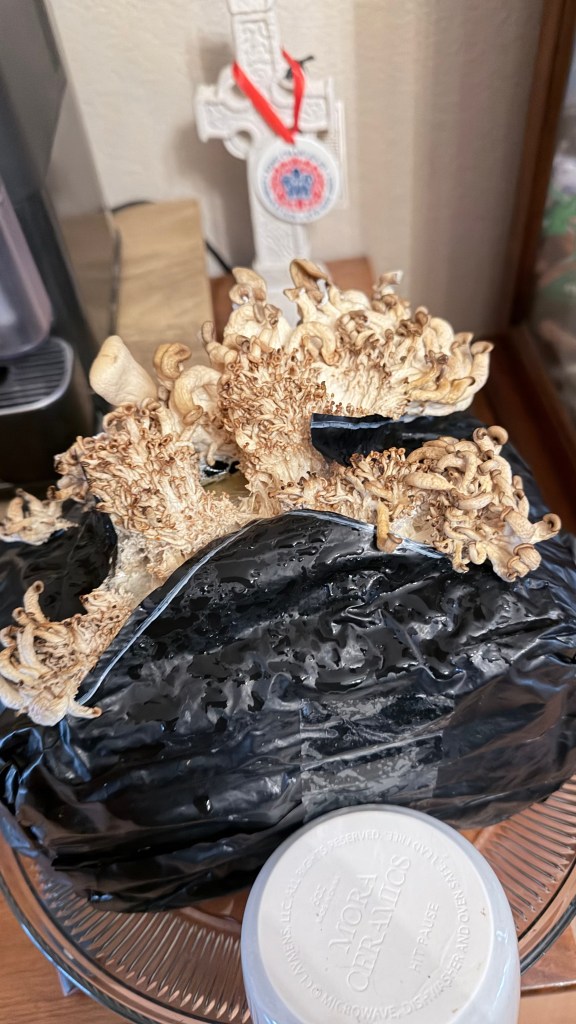
And then… Mindy died.
I mean, it looked like she truly died. Shriveling. Sad. A block of despair. No perk. No promise. Just the unmistakable vibe of something that had crossed over to the fungal afterlife.
This is not a place where I have any innate knowledge.
So I did what any confused Pacific Northwest gardener would do: I asked people.
I asked Gerald, and he had thoughts.
I asked Mildred, and she also had thoughts.
One said, “Add water. They’re too dry.”
The other said, “Increase airflow. They’re suffocating.”
Classic.
Unsure who to trust (and unwilling to choose sides), I did what gardeners have done for centuries, well, modern centuries, and consulted Facebook.
There are many mushroom groups on Facebook. So many. I randomly picked two and posted a photo of poor, withered Mindy.
Wow.
People have opinions.
Spicy ones.
You would think I was actively harming Sweet Mindy on purpose, possibly while making direct eye contact. The comments ranged from deeply helpful to vaguely accusatory to “why would you even try to grow mushrooms if you’re going to do that?”
Gerald, Mildred, and I sat down (emotionally) and sifted through the discussions. After much deliberation, we decided on a plan:
A very delicate trim.
And by delicate, I mean I cut everything off, right down to the base block, and decided we would simply… start over. Fresh slate. Gentle misting. Calm vibes. No more risotto-based decisions.
And friends…
We seem to be on the way to a second flush.
Tiny nubs. Hopeful little clusters. The unmistakable energy of a mushroom saying, “Okay, but don’t do that again.”
How is it going?
Too soon to tell.
But I’ll let you know
Dec 1st, 2025
Mildred, Mindy, and the Great Mushroom Debate
Christy the Gardener had planted many things in her day, tomatoes with opinions, kale that judged her life choices, a rosemary bush that might actually be immortal, but she never tried to grow mushrooms. Not once.
But Mildred the Gnome had been whispering about it for weeks from her mossy perch near the decaying hostas.
“Christy,” Mildred said one fog-soft morning, hands on her ceramic hips, “don’t you think it’s time we expanded the family garden? Something elegant. Something exciting. Something… spore-based?”
Christy raised an eyebrow. “You want mushrooms?”
“Not mushrooms,” Mildred corrected, “Oyster mushrooms. I saw a TikTok about it. They grow like little clouds. It is something for us to do in winter….while the garden sleeps.”
Gerald, her gnome husband, had thoughts as well. “They also decompose things. I approve.”
And so, $45 later, Mindy the Mushroom arrived to join the family.
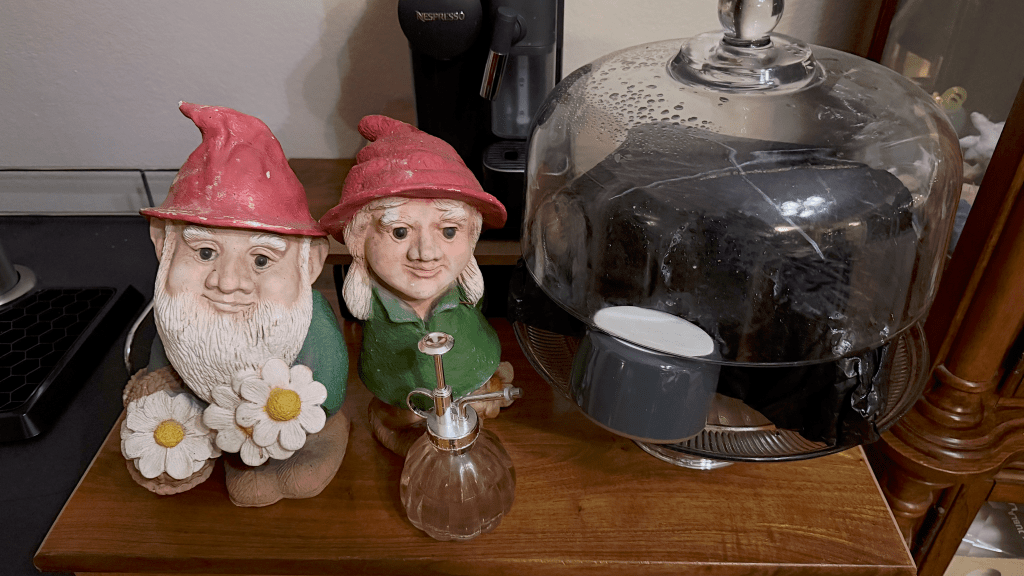
The directions called her an “Oyster Mushroom Grow Kit,” but Mildred insisted on naming everything that lived in the garden, so Mindy she became. She came wrapped neatly in biodegradable packaging, and her new home, per Christy’s thrifty ingenuity, was a glass cake stand with a domed lid, the very picture of fungal elegance. After all, she only made a cake once a year.
Christy read the instructions aloud while Mildred and Gerald gathered around like tiny, overly opinionated garden consultants.
“Cut a large ‘X’ on the surface,” Christy said.
They all nodded in agreement. It was the only moment of unity.
Then came the airflow debate.
“I once watched a TikTok about this,” Mildred began (her favorite and most dangerous sentence).
“You need substantial airflow. A plastic bag tent with holes. Mushrooms like drama. They need movement!”
Gerald nearly dropped his acorn clipboard.
“Absolutely not! Plastic? In this garden? Never! Simply prop the glass lid up a bit. Let the air in naturally. Mushrooms respect subtle ventilation.”
Christy stared at both of them, scrunching her face the way she always did when deciding between two equally questionable ideas.
“Look,” she sighed. “We spent $45 on Mindy. That means Mindy has to produce at least $45 worth of mushrooms. Preferably $50, if she aspires to excellence. We need whatever method gets the job done.”
Mindy, for her part, merely sat in her cake-stand home looking innocent, but Christy suspected she would grow better if the gnomes spent slightly less energy arguing and slightly more energy not breathing down her nonexistent neck.
Then, halfway through setting up Mindy’s new arrangement, Christy froze.
“Oh no… I’m traveling for the holidays. By car. What do we do with a growing mushroom block for a seven-hour road trip? The instructions say she needs to be misted a minimum of twice a day.”
Mildred shrugged. “Take her. Mushrooms like adventure.”
Gerald stroked his tiny beard. “Mindy must travel as a lap passenger to remain upright. Preferably buckled in. For safety.”
Christy pictured explaining this at a rest stop.
This is Mindy, my mushroom. Yes, she’s in a cake stand. No, she’s not a dessert.
Well… stranger things had happened in her household.
So it was decided:
Mindy the Mushroom would go on a holiday road trip.
Gerald would supervise airflow engineering from the dashboard.
Mildred would continue issuing TikTok-based wisdom until told to shush.
And Christy, thrifty gardener, reluctant mushroom mother, driver of a very odd carload, would simply hope that Mindy grew enough oyster mushrooms to justify her investment… and her growing reputation for eccentric produce companionship.
One thing was certain:
Mindy would not be ignored.
Not with all this attention.
And perhaps, just perhaps, that’s exactly what a little mushroom needs to thrive. How will the adventures of Mindy go? Stay tuned………
November 3rd, 2025
The Great Fall Prune, or How Not to Kill Your Fig Tree (Probably)

There’s a moment every fall when I stand in the garden, pruners in hand, and question everything I think I know about plants. “Cut here?” whispers my brave inner gardener. “Cut there?” counters the Plant Killer who lives rent-free in my head. Because pruning feels like surgery, but you didn’t attend medical school, and your patient doesn’t scream, it slowly dies over winter if you get it wrong.
This year’s patient was the fig tree. Oh, the fig tree. It is beautiful, prolific, and utterly uncooperative. You see, I planted it years ago on the edge of our terraced hill, thinking, What a picturesque spot! Yesterday’s self did not think ahead. Now, every summer, I stand halfway down the slope, one hand clutching a branch, the other stretching for the plumpest figs that hang just out of reach. It’s a perilous operation that looks like a mix between yoga, mountain climbing, and snack time.
So, this weekend, armed with the optimism of a new electric mini-chainsaw (and the supervision of the Builder, wielding the Big Cutters of Doom), we decided it was time. I had even done my “research,” which means I typed how to prune a fig tree without killing it before getting distracted by a squirrel stuffing an entire apple into its mouth.
We began delicately, like surgeons. He cut, I wrangled cords, and the gnomes, Gerald and Mildred Witherspoon, stood by with looks that said, Finally, the humans are doing something useful. But then came the big cuts. The kind where you stare, saw raised, and say, “Are we really doing this?” three times before committing. We debated. We reasoned. We consulted the gnomes (Mildred is pro-aggressive pruning; Gerald prefers a gentle trim). And then… we did it.
Now, the poor fig looks like a puppy that wandered into a bad grooming appointment, uneven, a little embarrassed, but hopefully relieved. I told it softly, “You’ll thank me next summer,” while the Plant Killer whispered, “Or maybe you won’t.”
If you’re out there facing your own pruning fears, here are a few hard-earned fig and blueberry lessons from the hill:
Fall Pruning Tips for the Slightly Nervous Gardener
- Figs: Wait until they’ve dropped their leaves, then prune lightly. Take out dead or crossing branches first. If you need to shape it (or shorten a skyscraper fig like mine), cut back one-third of the height – no more! Figs forgive a lot, but not a hack job.
- Blueberries: Go for the old gray wood. New, reddish stems = next year’s fruit. Old gray wood = retirement. Remove a few of the oldest canes each year to keep the plant youthful and productive.
- Channel your inner gnome. Step back often, squint, and mutter thoughtfully before cutting. A good playlist doesn’t hurt. I recommend putting on something by Hollow Coves and not The Killers (for obvious reasons).
- Don’t panic. Plants are sturdier than we think. Nature knows how to recover from our learning curves.
- Reward yourself. Pruning deserves a cup of tea, or something stronger, and a moment to admire your bravery.
So here’s to the brave fall pruners of the Pacific Northwest. May your cuts be clean, your balance sure, your gnomes approving, and your yard waste bin not overly full.
October 24th, 2025
Hello from the multi-tiered wooden high-rise you humans call a worm bin! We Steves (yes, all of us are Steve—it’s easier that way) have been doing Very Important Soil Work all summer long. And now the nights grow chilly, the rains return, and the Gardener peers into our cozy compost condo with that worried look again…
“Will the Steves be okay? Should I knit them tiny hats? Little scarves? …No gloves, obviously.”
We love her concern, but we also remember the Great Knitting Attempt of 2022, in which she produced one long, confused rectangle before abandoning the cause when she got bored. So perhaps we will skip the accessories.
Instead, here is our official guide to…

How to Prepare a Worm Bin for Winter in the Pacific Northwest
(Approved by Steve the Worms, written by someone with thumbs)
Pick the warmest spot possible
Under a covered porch, against the house, in a garage, or in a shed –
We Steves do not wish to go skiing. The Steves live up against a back fence, sheltered from the wind.
Feed us a winter feast (but not too much!)
A good layer of food scraps + a thicker blanket of bedding keeps microbial party heat going.
Think: lasagna layers → yum + insulation!
Add insulation like we are VIPs at a tiny worm ski lodge
Cover the bin with:
- Dry leaves
- Straw
- Shredded cardboard
- An old blanket or piece of foam over the lid
- (No space heaters, please – we are squishy, not crispy.)
Raise us off the cold ground
Cold seeps upward!
Bricks or a pallet underneath = worm slippers (metaphorically – remember previous discussion about knitting).
Keep drainage clear
Pacific Northwest winter motto:
If it’s not raining yet, give it five minutes.
We hate puddles. Moist, yes. Drowned, no.

Let us slow down
Our winter mode is:
“Hibernate-ish, snack occasionally, and dream of tomatoes.”
We may not munch as fast – but don’t worry. We’re still here, wiggling and plotting spring.
Optional: The Steve Spa Treatment
For extra love (as if hats weren’t enough):
- Add a few handfuls of finished compost or soil → beneficial microbes & insulation
- Tuck newspaper around inner edges like draft-stopping curtains
- Whisper: “You are good worms. Excellent worms. I love you, Steves”
We like affirmation.
The Gardener’s Final Thought
She closes the lid, hears our soft, happy squish-sounds, and breathes a sigh of relief:
“Okay. Maybe no scarves. But you Steves better be here in spring.”
We will.
We are winter warriors.
We are soil soldiers.
We are THE STEVES.
October Garden Tasks in the Pacific Northwest
By Gerald Witherspoon, the gnome
Dear sprouts!
The crisp breath of October is drifting through the garden, and while the squirrels are frantically stuffing their cheeks, I find it’s the perfect time to talk about what you should be doing in your Pacific Northwest garden.
Let’s dig in, shall we?
🍁 1. Leaf It to Compost
The trees are dropping their golden and russet cloaks — don’t rake them all away! Shred them and pile them into your compost bin or use them as mulch. They’ll break down into something magical for your soil by spring. Just don’t smother your perennials; we want to tuck them in, not bury them.
🌷 2. Bulb Bonanza
Now’s the time to plant spring-blooming bulbs like tulips, daffodils, crocuses, and my personal favorite — fritillarias (so delightfully peculiar). Get them in the ground before it freezes. The rain will help settle them in, and come spring, you’ll thank your October self with a blooming bouquet of joy. Just watch for squirrels who will come and dig them up.
🧄 3. Garlic: Plant It and Forget It
Ah yes, the noble garlic clove. Nestle it into the soil now, pointy end up, about 2 inches deep. By next summer, you’ll have a stash fit for roasting, pickling, or warding off garden ghouls. Is there anything better than roasted garlic?
🌧️ 4. Tidy, but Not Too Tidy
I know you humans like a clean garden, but resist the urge to over-prune. Leaving seed heads (like those on echinacea and rudbeckia) gives winter interest and feeds the birds. Besides, we gnomes enjoy the spooky silhouettes on foggy and misty mornings.
🌿 5. Weed While It’s Wet
The soil is softer now, making it easier to pull those pesky weeds out by the roots. Get them before they drop seeds or go dormant to haunt you next spring.
🛠️ 6. Store the Garden Tools
Christy is a great gardener, but she is always leaving her tools scattered around the garden beds. Bring them in, wash them off, and let them rest for the season.
🍻 7. A Toast to the Garden
Pour yourself a mug of something warm and step outside. Smell the earth, admire the mushrooms popping up in shady corners, and whisper your thanks to the plants for their hard work this year. They’ve earned their rest. And frankly, so have you.
As the days grow shorter and the rains return, remember: gardens don’t die in the fall, they transform. Rest is part of the rhythm. So layer up, listen to the chickadees, and don’t forget to leave a little offering for the garden spirits (we love oat cookies, just saying).
Until next time,
Gerald 🌿
Keeper of the Kale Patch & Guardian of the Garden Hose

 The Enchanted Trowel